Well burrowed, old mole!

Essays on Philosophy

Category: Signifying Practices

Laclau Notes Session 4: Contingency in Theory

1. Back to the Ancients

     The most ferocious attack on Rhetorical Theory came from Plato.  He claimed that rhetoric had no epistemological value at all. Rhetoric is concerned with the discursive movement of deliberation and not the question answer and two term choices which dialectic employs. In the Gorgias, Platon condemns rhetoric because it offers no coherent account of its own status as a form of knowledge, and because it is not possible to delineate a class of objects with which rhetoric is concerned.  Rhetoric is nomadic; it has no specificity and no domicile.  It is to be considered defective and incomplete by a Platonist because it offers a false ontology; it deals with the appearance of truth and good not the definition of the truth or the good.  It offers no epistemological certainty or foundation.  Above all, Plato judged rhetoric to be an amoral instrument of practical politics, unlike ontology and epistemology of course.  A paradox emerges from this account: though rhetoric is tangible and deals with the tangible its arguments cannot stand up to critical scrutiny. 
Read the rest of this entry »

Laclau Notes Session 3

Review of the History of Rhetoric in Relation to Philosophy

1. The Ancients-Form and Matter     

     For the Greeks, what is sayable of an object is universal, but we must ask, what is the “it” which receives the predications?  For the Greeks all predicables are universals; they make up the form or the rational and knowable part of the entity of the object.  The “it,” the irrational and unknowable individuation that remains when you take away all predicables, is called matter. The Greek thought of the universe as a scale.  At the bottom was the unnameable primary matter hyle.  The first principle of organization was the mineral world where form was imprinted on this primary matter.  The mineral world was as matter to the vegetable world, the vegetable to the animal, the animal world to man, and on top the Gods were pure form and stood as matter in relation to nothing.  

Read the rest of this entry »

Laclau Seminar Notes Session 2: Floating Signifiers and Heterogeneity

614d92f60a37cc6f9ddc73a949e5c091


  • The Moment of Hegemony

 Screen Shot 2016-03-27 at 12.36.23 PM    

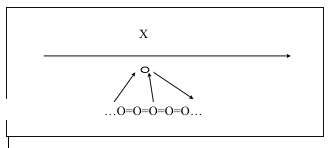
This is a simplified depiction of the moment of hegemony.  The X represents those on top of the frontier.  The antagonistic frontier can be said to be power, the X is sometimes a government.  It can also be the ruling class within a society.  The O’s below the frontier are the oppositional desires or the demands of those who are below the line.  The oval which is raised above the Os is the empty or hegemonic signifier, the arrow shows its origin from a particular desire or demand. These particular demands are arranged in an equivalential series by the emergence of the hegemonic signifier, the universalization or emptying of the hegemonic signifier is represented by the lines stretching from the oval to the chain of Os. 

This is a depiction of a situation in which those who are below the frontier of power have a series of demands which are unmet, and though their demands are different from one another, those who have these differing demands come to see them as equivalent and form a group under the articulation of one particular demand which comes to stand for opposition to X.  For instance, if many people have needs which are unmet in present day America, such as the need for affordable housing and health care, the desire to have more efficient garbage pickup in their neighborhood, the desire for a humane foreign policy and so on, they may end up campaigning for these diverse goals through the mediation of a group which articulates a different demand.  If these demands remain latent in the population, at any given moment if another group launches a large scale protest those with latent demands may join it even though it does not articulate their particular concern because it articulates unmet demand. 

     The X is in fact a group of people.  In order for them to maintain their position above the frontier, they must restrict the formation of such an equivalential logic.  If those who live under power can form a large enough equivalential chain they can overthrow those who are not meeting their demands.  There are two means by which the X will seek to keep the equivalential chain from forming, by articulating a logic of difference, or by constructing an alternative logic of equivalence. 

Read the rest of this entry »

Critical Notes on Ernesto Laclau’s Seminar on Rhetoric and Hegemony

Session 1: Introduction to Laclau’s Theory of Hegemony

gramsci

1. Illusions of Modern Bourgeois Philosophy

     At the beginning of the 20th century three new developments in philosophy were taking place.  Each was based on a strategy which its proponents felt could grant immediate access to the thing in itself. The three strategies were analytic philosophy, phenomenology and structuralism.   All of their key words (referent, phenomenon and sign) played the role of what Levinas called a “neutralizing third term” they appeared to efface themselves in the process of bringing forth the unmediated truth of the world.  As time passed, these third terms became increasingly visible to practitioners of the strategies which they founded.  In the work of the late Wittgenstein and Richard Rorty, Martin Heidegger, Roland Barthes Jacques Lacan and Jacques Derrida we see a realization that the founding notions of 20th century philosophy did not grant the immediacy that they had promised.

Read the rest of this entry »

Notes on the Linguistics of Pecheux

monsieur-de-la-palisse

Notes are based on :

Michel Pecheux LANGUAGE, SEMANTICS AND IDEOLOGY  © Francois Maspero 1975 English translation © Harban, Nagpal 1982

Read the rest of this entry »

The Problem of Postmodernism

stock-vector-coin-operated-automaton-153307646

In his essay, “Twilight of the Machines” John Zerzan speaks the truth about the “postmodern” age.  He is not a scholar in the bourgeois university,  as many other critics are, which means he does not have to jump through the hoops of academic convention; he may speak the radical truth. Zerzan speaks as a philosopher and a revolutionary, breaking radically with the “Washington Consensus” of market totalitarian society. 

Read the rest of this entry »

Consensus and Violence

houghton_ec-b1328-620ib_-_novum_organum_scientiarum

As Lord Bacon said, scientia potentia est: knowledge is power. Bacon warns the inquirer, the natural philosopher against the ‘four idols’– various forms of social prejudice– as obstacles to inquiry, and claims elsewhere that his inductive logic is superior to Aristotelian logic because it can be used to create new knowledge that makes life better, not merely to codify established truths. This seems like a great idea, science alleviating human misery; however, for Bacon, science can only investigate nature, it cannot inquire into matters of church and state. 

Read the rest of this entry »

On The Origin of Human Knowledge

g1code

A Cluster of Problems

I.  Series’ and Meaning                                                            

When we think of the meaning of words, we think usually of their use in propositions and sentences.  Some of these sentences are attempts at definition by various dictionaries and scientists and so on.  If we look in greater detail at these definitions we can see that they refer to other definitions, which in their turn refer to other definitions.  This is called the ‘infinite regress’ and this is the essential and irreducible feature of language, its fundamental truth. 

     It is possible to view this chain of reference as being one of many which construct a web or a field which is the matrix from which uses of language draw, and which, on the whole, constitutes a language’s semantic structure.  When looking at definitions, we see certain concepts or signifiers which are used in an attempt to stabilize the system of reference.  These can be called centers, and language can be said to rely on a network with multiple centers from which it draws meaning.

     The idea that language has stable meaning is analogous to the way a counterfeit bill remains ‘legitimate’ so long as it is passed from hand to hand.  What this process requires is not a positive belief in the legitimacy of the bill; it requires the non-presence of disbelief in the bill’s legitimacy.  Despite what the logician might say, ‘I believe’ and ‘I do not disbelieve‘ express two differing positions. One of which is a positive belief and one of which we can call a negative belief.

      Read the rest of this entry »