Well burrowed, old mole!

Essays on Philosophy

Category: Plato

Laclau Notes Session 4: Contingency in Theory

1. Back to the Ancients

     The most ferocious attack on Rhetorical Theory came from Plato.  He claimed that rhetoric had no epistemological value at all. Rhetoric is concerned with the discursive movement of deliberation and not the question answer and two term choices which dialectic employs. In the Gorgias, Platon condemns rhetoric because it offers no coherent account of its own status as a form of knowledge, and because it is not possible to delineate a class of objects with which rhetoric is concerned.  Rhetoric is nomadic; it has no specificity and no domicile.  It is to be considered defective and incomplete by a Platonist because it offers a false ontology; it deals with the appearance of truth and good not the definition of the truth or the good.  It offers no epistemological certainty or foundation.  Above all, Plato judged rhetoric to be an amoral instrument of practical politics, unlike ontology and epistemology of course.  A paradox emerges from this account: though rhetoric is tangible and deals with the tangible its arguments cannot stand up to critical scrutiny. 
Read the rest of this entry »

Laclau Notes Session 3

Review of the History of Rhetoric in Relation to Philosophy

1. The Ancients-Form and Matter     

     For the Greeks, what is sayable of an object is universal, but we must ask, what is the “it” which receives the predications?  For the Greeks all predicables are universals; they make up the form or the rational and knowable part of the entity of the object.  The “it,” the irrational and unknowable individuation that remains when you take away all predicables, is called matter. The Greek thought of the universe as a scale.  At the bottom was the unnameable primary matter hyle.  The first principle of organization was the mineral world where form was imprinted on this primary matter.  The mineral world was as matter to the vegetable world, the vegetable to the animal, the animal world to man, and on top the Gods were pure form and stood as matter in relation to nothing.  

Read the rest of this entry »

Plato and Ideology

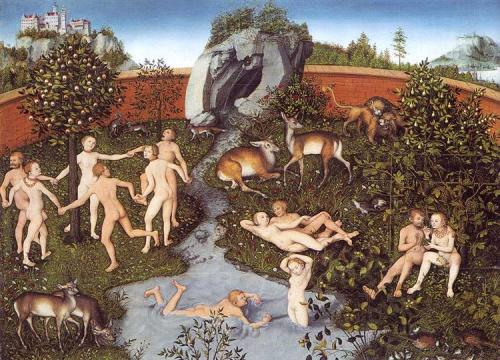
golden-age  

The most significant lesson that I draw from The Republic is that so long as there is luxury–i.e. class rule–there will be deception and tyranny.  The ‘city of pigs’ that Plato rejects is the crucial point in the story for me. I read Plato’s utopian writing as more of an exercise in following ideas to their conclusions than as manual for statesmen. What Plato does in this work is he attempts to rationalize privilege and he fails at it.  The book demonstrates the fact that privilege cannot be justified without using mass deception combined with censorship and the state sanctioned indoctrination of children.  The friends assembled to discuss justice do not reject the ‘city of pigs’ because it cannot be the just city, but because they (being from the privileged class in Greek society) were accustomed to a standard of living that involved luxury goods.  If they are privileged and they are the only ones in their society who have access to luxury goods, then to say that the city must have luxury goods is as much as to say that the city must have privilege. 

Read the rest of this entry »