Well burrowed, old mole!

Essays on Philosophy

Category: philosophy

A Modest Proposal for Revitalizing Philosophy

(a) context          

     In every generation, someone makes the claim that philosophy is dead, and yet, like the ever-imminent Christian Apocalypse, this death never seems to come.  History is done, philosophy is dead, the stars are not wanted now, put out every one, pack up the moon and dismantle the sun etc etc… This mentality of self-pity or whatever you want to call it usually is the result of taking some theological, philosophical or scientific hyperbolist a bit too seriously.  Wittgenstein did not murder philosophy with the Tractatus, nor Hegel with his Phenomenology,  nor Fukuyama with his End of History, nor Dewey with his frightful pragmatist nonsense, what they did was to provide a certain type of enabling optical illusion, an excuse for the tired, for the weary for those whose fantasy was such a death to seize upon. 

        Philosophy will never die as a result of its problems being “solved” or “dissolved.”  It will only be clinically dead for as long as a people lack imagination enough to practice it.  The definition of philosophy in these terms falsifies it.  Philosophy is about the creation of the problem, about posing a problem, about problematization, not about reconciliations or solutions. As soon as one “problem” is “(dis)solved,” life has already thrown another mountain in the way of the sensitive mind.  As Emerson put it in his essay Circles:

Read the rest of this entry »

Marx and the “Death of God”

kapitalstamp 

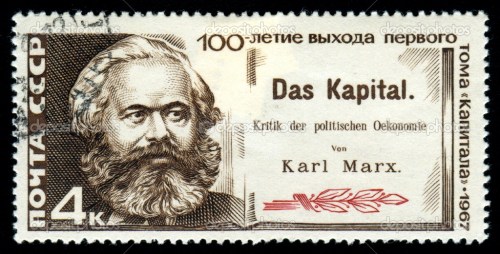
    It is remarkable that so many postmodernists seem to mourn the death of God.  The fact that the totality is no longer total, that there is no ultimate mystical reality behind the world seems to disappoint these people.  Their writings show a pathetic nostalgia for the total even as they proclaim its opposite. 

Their actions are a part of the tradition which they place themselves over against.  We can begin with Plato and Socrates, in their confrontation with the sophists. The problem with the sophists was that their art was nomadic; it had to be domesticated.  The sophists did not teach a transcendent term that should govern all discourse, their way of teaching was foundationless.  It seems that Plato was a brilliant sophist, who appropriated many sophistic techniques in order to compose his works, but then turned around and attempted to declare himself the last prophet.  His theory of the forms is a theory of the beyond, one which falsifies the life-world and subordinates it to external concepts.  The bottom line, the most essential characteristic of Plato is his insistence on the universality of values.      

Read the rest of this entry »

Faust Frankenstein Prometheus

I think these three works are highly useful for thinking through the problem of technics/knowledge.

Prometheus and Epimetheus–This story from Plato’s Protagoras  shows, as Steigler has described, the originary techincity of human beings.  It shows the way that the problem of technology is radical for human beings and for thinking about the history of this species.  It also ties into the problem of stupidity as Deleuze expounds it, “animals are protected by specific forms” from stupidity [betise]. This story gives an account of this absence of specific form in the human being.

Faust–This play, by Goethe not Marlowe, against complacency.  When Faust stops striving to be god-like, he loses his soul to Mephistopheles. Mephistopheles will serve Faust so long as he does not become complacent. This conditional mastery that Faust enjoys depicts the situation of the human race in the face of technics.  Faust must fight complacency in order to keep his soul, if he becomes complacent, Mephistopheles takes the soul, it is his by the terms of their agreement.

Frankenstein–This novel depicts a terrible experimentation. Dr. Frankenstein in many ways re-enacts the story of the Golem, but this time it is via electricity harnessed through secular science that he does the deed.

Reflections on Revolutionary Consciousness

jonesumm1_1413046a   

    We must begin by acknowledging a presently existing form of anarchy, one which is largely dormant, but one that can become more manifest. In other words, we must begin by acknowledging that all existing hierarchies are based on the quasi-voluntary association of free persons to a much greater degree than is generally conceded.  Most Americans, and citizens of first world countries, live a large portion of their lives with no actual hand holding a gun to their heads and forcing them to obey anything.  Most of these countries right now run on “auto-pilot,” most people regulate themselves for the system, or more precisely are regulated under their own supervision for the system. One can even hypothesize that, following Sartre’s discussion of the solitude in which the reception of a command leaves one, without self-organization no institutions are possible at all.  In practice, there are groups of people who claim to be in charge and so on, but if their so-called subordinates do not use their own creative capacities to carry out the directives they are given nothing at all would be possible except frustration.     

     A great mass of consciousness is currently configured in such a way as to make a realization of the fact that we ultimately regulate ourselves in the interest of a system which exploits us unthinkable or at least very difficult to think. If this is difficult to think, the thought that we could reorganize in a different way should be impossible, but this is not the case.  How are people led to forget the anarchy of the pure present which is the first experience of life and its prevailing atmosphere for much of early childhood? The answer is two fold, they are not, and an attempt is made to do so by various means which it shall be our task to explore, these are commonly called “mainstream culture”.  People never forget this experience because it recurs in life very often; this is the case when one witnesses a crime, or when one is present at a momentous conjunction of forces, it is the sensation of suspension of the law.  We feel for a moment that law only exists in the past and that right now that could cease to be the case.  In this type of moment we have a taste of something, something which has been subject to manipulation and mystification for far too long. 

               It is a corollary of this position that authority is quite different than many people imagine it to be.  Mao was quite correct when he characterized the United States as a ‘paper tiger’ implying that its power was possessed of a different type of substance than it would have us believe.  This is a good figure for all authority; authority is not power, and we confuse the two at our peril.  If we wish to choose a similar image, possibly more familiar to most people in the United States, we can say that authority is a “scarecrow” or a “straw man.” How does the scare crow function? How is it possible for the paper tiger or the straw man to compel and discourage behaviors? Kenneth Burke almost explains this when he discusses the issue of  the externality of voices to the individual mind.  He claims that an external voice can never successfully compel anyone to do anything unless it is internalized, but he neglects the fact that the external voice does not just penetrate the skull by osmosis. One is not penetrated by the voice, one becomes the voice and the voice becomes one.  The farmer only has to chase the birds a few times and put up a straw man, then they regulate themselves through fear, he does not have to be present in the field at all times, yet the crows act as if he was. The important point here is that the farmer has power, and the birds have power; now, the farmer puts the straw man in the field and the crows endow it with significance, they regulate themselves based on this attribution of meaning.   Similarly, in intra-human affairs authority does not compel submission; most of what we would classify under this heading should be thought as participation in the most concrete sense in the legitimation of law. No law is ever fully legitimate but it is a constant process of legitimation.  Thus, we can say that authority depends for its force on the actions of those over whom it is said to be wielded. Authority is the legislative power, the force which is the law which never achieves legitimacy. That this should continue to return, that it should be reproduced on a daily basis bespeaks a complicity in the creation of one’s own manacles which is the basic principle of politics. 

     Thus, we can see that authority has a ritual character, and as Joseph Campbell has claimed, ritual is the enactment of myth. However, it seems that thinkers like Campbell and Eliade have performed an inversion here.  It seems that myths are both a sublimation of the individual’s role as participant in the reproduction of authority, and consumption of such myths is a form of such reproduction at the same time.  Rituals in the anthropological sense and rites of various kinds are attempts to instantiate a world in which the apologetics of the myth become truth. In the case of American society, we can formulate one example among many as follows: the first term is the oppressive workday in the work or starve environment of mutual hostility, the myth is the American Dream world of advertisements, and the ritual is the act of watching television, or visiting places such as Disneyworld where the corporate dream-world displaces focus from the life-world which surrounds it and in which its values are empty and unwelcome. However, the ritual act of watching television does not end when one turns off the set to retire.  Cues for the television watching mind exist dispersed throughout reality and the right cue can effect a televisionification of the life-world, a moment in which decisions about non-television situations are made based on principles derived from television shows. This effect is very important in the propagation of authority, but the basic principle which we can extract from it is more important.  When we say that decisions are made based on television principles, what we actually mean is that memory of the television displaces the concrete situation, the ‘social rules’ values and modes of conduct which are manifested on the television come to be identified with those which are at play in concrete non-contrived situations, memory of the television is equated with social experience, and displaces it. Thus, we can say that the basic currency of authority is memory, the creation organization and direction of memory is what keeps authority in existence.  Consciousness is composed of memory and attention and we must assert that attention is under the power of memory in most cases, in our first moments of life we have openness, but it gradually accumulates memory, through means I shall discuss in the next paragraph, which transforms it into attention and hence consciousness, most times we see what we remember to look for.

    Nietzsche has shown us how authority creates memory through violence, more specifically through cruelty.  Walter Benjamin echoes this in his discussion of the legislative force of violence.  Benjamin states that violence can be law-making, law-maintaining, or law-destroying.  What authority is composed of are disconnected acts of violence and memory networks which attempt to link them in such a way as to make them seem connected, apologized for, and justified. How are memory networks established? They correspond inevitably to networks of violence, something like Canetti’s sting of command circulating through a group, hey he kicked me so I’m gonna kick you.  The act of violence is not justified we are made complicit in it, we reproduce it and thus remove the need for justification.  In the case of America, we can say that the first law making violence was simultaneously a law-destroying violence, the revolution against England and today’s networks of law-maintaining violence occur in situations of mass audience concentration such as school-houses.  However, for the concrete individual the first acts of law-making violence are committed against them by their families who commit them as semi-conscious acts of law-maintaining violence. These acts prepare children to endure the imposition of ‘discipline’ in the schoolhouse.  The parent knows a certain sadism of command combined with paranoia, I love you but what will the others think if I do not do this coupled with how dare you resist what I do for your own good you’ll do it because it is my will.  In this case, what the parent is doing is appropriating the imperative of their own paranoia about the group, and achieving the filthy  jouissance of complicity in the crime which oppresses them in inflicting it on the child. These forces derive from the parent having undergone the same violent inscription as a child and having endured law-maintaining violence in the form of the barking sadistic boss and the merciless ticking of the office clock, as well as the hazing received as a condition of affiliation for many groups.     

     When we think, Why bother going to work, why should I? this is not depression or laziness, ( a la Nietzschean bas conscience) but a call to action in another direction, a call to form a new type of society in which joy and desire are valued rather than order and structure. It is no coincidence that we do not value order and structure until we are taught to.  These values are in no sense directly related to the pursuit of our own well-being or that of our families, they are in all instances code words for other values which if revealed would be immediately rejected.  We are told by institutions to value order and structure in our lives as a matter of their convenience, for example, a slave owner in the south would have said that he hanged a black man to maintain ‘order’ what he actually means is the order of things or the status quo.  Or today, an educational institution values the eight hour school day because it reproduces the corporate workday, and engraves it as the immutable form of normalcy in the formative period of early childhood, but the spokespersons of this way of doing things will say that it is necessary for the child to have ‘structure’ in their life.  Each of us as a living being resists stasis on the cellular level, order and structure are inimical to life if they are raised above it. 

      This question why bother? comes to most of us as an overflow of the energy of life in us wishing against ‘reason’ to cast off our shackles and live, it does not bespeak a lack of motivation it indicates a damming of the flow of desire which we seek to remove in spite of all of our so-called education.  It indicates a greater motivation to greater acts which we cannot achieve from a cubicle, acts which require that we have the time to determine our own lives and do not have to serve the system for the entire period of daylight 300 days per year.   However, the realization of the significance of this impulse, the comprehension of our own vital flows is not yet at the level of conscious awareness. In fact, the present form of social organization depends for its continued existence on the hope that this awareness will remain submerged, that this type of lucidity about our own power and this type of seizure of the power of meaning attribution over our own mental states will never come to presence in the majority of people, or even a significant minority. The system produces thousands of well-paid experts who tell us that there is something wrong with the person who does not want to live the majority of their life in a cubicle under fluorescent lights, who does not want to come home to the dull hum of the television every night.  These experts will claim that this person should take pills which help them adjust to that life, these experts never even countenance the possibility that the society is flawed, not the minds of the people.


The Great Revolution

m485a92052b971

I. Anniversaries      

     As the 25th anniversary of the fall of the Berlin wall approaches we are called to reckon with the twentieth century and what it really meant. At the time when the wall fell, we were told that History had come to an end, that liberal democracy was the final term of human social evolution, that capitalism had triumphed, that there was no alternative, that markets had shown themselves as the only possible basis for organizing the human metabolism with nature. We were told that this event was demonstrative proof that anything other than capitalism doesn’t work.

          That was the immediacy of the moment, but now that 25 years have passed, we are called to think this through with a bit more depth. What was the real meaning of this event–the fall of the USSR and the GDR the dismantling of the soviet republics and so on. What did it mean? It was impossible to say at the time because the meaning of this was still in the future.  The meaning of this event would be the capstone of the 20th century. The meaning of this event would be the doorway into the 21st century.

         On  the 100th anniversary of the Russian revolution, where will we be?  How will we answer to the tens of millions whose world-historical refutation of fascist irrationalism set the tone for the latter half of the twentieth century? Now we stand back with a bit of distance, with the accumulation of 25 years of action and reaction. We can now see how things stand and say with confidence: what happened in 1989 was the triumph of injustice over justice on a global scale. 

II. Imperialism

     There has been a feverish production of names for the system that we live under.  The bourgeois press has been busy producing words and phrases, up to and including a discourse on the impossibility of naming the system we live under. Hardt and Negri, along with many others, choose to say “empire,”  Guattari chooses to call it “integrated world capitalism,” still others will call it “technological society” or some variant of the technological motif–industry, information etc etc. Then there are those who speak of societies of control, of hyperindustrialism, totalitarianism and so on. Still others see it as a fundamental pathology of civilization and civilized life as such and so on. These names are ideological and dishonest–many are critical efforts devoted to an uncritical task–talking away the fact of imperialism.

     What we have is not empire, nor is it capitalism, nor is it civilization, nor is it globalization or its more cosmopolitan form mondalisation. The system we live under is full-blown imperialist capitalism with concentrated finance capital calling all the shots–the system that Lenin was talking about in his pamphlet on imperialism. As common as it has become in ‘enlightened’ bourgeois circles to give some kind of credit to Marx after the crisis of 2008, Lenin is the theorist of the type of capitalism that we actually live under and we act like he doesn’t even exist.


The Stoics and First Philosophy

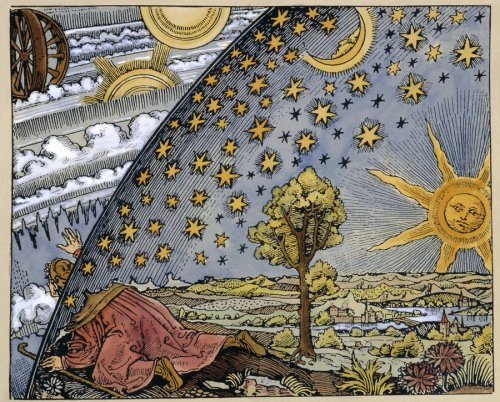
The Stoics offer us a key to developing an egalitarian alternative to ontology. A Stoic line of reasoning might proceed as follows. All relations are cosmic relations.  By definition, the cosmos is an inter-related totality. We call this the logos. Hence we do not have ontology, we have philosophical cosmology. Instead of the ontological difference, the conditional relation is our first principle. 

flammarion_engraving_custom-741e49ab7cc68a364f290fd15634c3c1f2ee30e5-s900-c85

The cosmos is the material embodiment of logos, it is the practical, corporeal enacted logos; but this same process is at work in our minds. Our minds are products of a certain series of cosmic relations—combinations, transformations and so on—which are also the inevitable contents of our thoughts. Our minds are capable of grasping the relational backgrounds that bring them into existence. This is the cosmological foundation of materialism.

We can achieve grounded materialist objectivity if we want to because we can gain enough information from our environment to explain the material foundations of our own thought processes.

The logos is thinkable for our minds because it is the set of physical preconditions for the existence of the mind—in a sense they are impressed upon the mind, as in evolutionary predispositions like breathing seeking to escape fire the physical knowledge involved in walking and so on.

These evolved instincts are millennia of adaptive activity compressed into our bodies. They express a subconscious logic in which the conduct of our lives is indistinguishable from the surroundings, an ongoing logical process in which we participate.

Real logic has content, it is in the form of conditional relations. All formal or subjective logics derive from this material and practical foundation—the cosmos is structured as a totality of conditional relations—the subjective formalistic logic seeks to negate the content and neglects the conditional.

Conditions must always preceed categories.

De Quincey as Philosophic Historian

The Last Days Of Immanuel Kant

On Murder, Considered As One Of The Fine Arts {Descartes Hobbes Spinoza Kant Malebranche Berkely

The German Language, And Philosophy Of Kant

A Peripatetic Philosopher

The Literature of Knowledge and the Literature of Power

Fasting Aesthesis Desire

Yesterday I was fasting sortof. While not eating, I was walking around the airport and marveling at a lot of food but without hunger for it. I explained that I was taking an “aesthetic” interest in the food and not an acquisitive one.  A “purely aesthetic interest in it”…what does that mean? Aesthesis is sensing as such—so it could not have meant a visual but also a tactile, a taste, a smell and so on.  I was allowing the food to stimulate me in some sense, but not my desire to consume it. It was then I realized that aesthetic experience is something that acts on the boundaries of our desires, it is not so much that aesthetic experience provokes desire, but that it gives us something to use to recalibrate, to reconstruct our desires.  This is vital in a capitalist world in which one of the main obstacles to autonomy is the pernicious operation whereby people pre-match the bounds of their desire to what the market is willing to offer them at any given time whether it is products services human relationships etc …

Postmodernity?

     What I want to question are the implications of a commonly asserted periodization; namely, the idea of the postmodern, summed up by Lyotard’s maxim on incredulity toward metanarratives. It seems that this idea of the postmodern may blind us to certain political and cultural realities that merit attention. Lyotard’s theory, like any theory is something of a microscope, allowing for insight while narrowing our focus. It may be the case that Lyotard captured in his theory an important intensity, a specific singularity of the era in which he wrote.  Granting this, we have lived through some decades and many events since that time, and a critical revisitation of the idea of the postmodern is in order.  In this essay, I hope to show that the incredulity that Lyotard made famous was not specific to his era; in fact, it had been at work in history for decades before he encountered it. If we accept such a vision of the postmodern, we may be accepting both more and less than we expect; in an era like our own one that seems to be possessed with a neo-medieval level of fanaticism and millenarianism, we may be sacrificing more insight than we gain.   I will being with a discussion of Lyotard and a discussion of metanarratives and eschatologies; following that I will contextualize Lyotard’s theorization of the postmodern with the Nietzschean and Heideggerian theorizations of nihilism, and finally with contemporary political and cultural events.

I. Background


    A metanarrative is a story that would give universal meaning to history.  There have been many metanarratives, and two of the most common are Christianity and Marxism, though there are many others.  The Christian and Marxist metanarratives can also be called eschatologies, this word comes from the Greek for “last” (eschatos) and “study of” (-ology), and an eschatology is a story that is concerned with the ultimate destiny and meaning of the world, and of life.  Both of these ways of thinking see history as a plane of unhappiness and alienation.  The Christian eschatology culminates with a transcendent agency annihilating history for the sake of a higher realm, while the Marxist narrative ends with people within history bringing it to a close by ending alienation and exploitation through political and economic action. So, we can see that both of these eschatologies include much discussion of history, but culminate in something other than history.  As a sort of midpoint between these two, we have the meta-narrative of Enlightenment modernity; according to this narrative, history is the story of the bold fight of an enlightened elite struggling to protect accumulated scientific knowledge and principle of the application of Reason to public institutions from superstition and authority; protecting the idea that public life should be based on freedom and equal rights and the idea that through change and action we can make life better.

   According to Lyotard, people are increasingly skeptical toward this type of story. Something seems to have changed in the relation between the people and certain metanarratives. It seems that the once liberatory narrative of Enlightenment and modernity has lost its street credibility in the wake of a number of developments in the world including the betrayal of the revolution by Stalin, the abandonment of the revolution of ’68, capitalist incorporation of trade unions and workers’ parties, and so on.  It has become increasingly apparent that the metanarratives of opposition and liberation, in order to remain metanarratives, needed to be complicit with the very power structures they would liberate people from. It can also be thought of as the autocannibalism of Reason, which neglected to neglect itself in the work of demystification.

II. Lyotard, Nietzsche, Heidegger


      How does Lyotard’s postmodern condition look when we bring it into relation with Nietzsche’s “Death of God”?   In the wake of this death, any transcendent value system, any beyond, becomes unbelievable; this includes knowledge, truth, reason, good, evil, and the other members of the secular pantheon. The rug is pulled out from under all symbolic values, especially those that propped themselves up against religion. In order to explain modernity and the transition from modernity to whatever follows, we should refer to two quotes from Nietzsche, first his statement that “God is dead; but given the ways of men, there may still be caves for thousands of years in which his shadow will be shown.[1]”and second “The event itself is far too great, too distant, too remote from the multitude’s capacity for comprehension even for the tidings of it to be thought of as having arrived as yet.[2]”

     Thus, we can understand ‘modernity’ as a bubble that opened up, wherein God had died or was dying, yet the residue of theology was left behind and adapted to ‘worldly ends.’ It seems that Lyotard is heralding the arrival of that death on a scale larger than was to be seen in Nietzsche’s day. However, this death is a process underway since long before the postmodern era; looking to Nietzsche, we see it underway in the late nineteenth century. Nietzsche’s thought on the matter of nihilism had a disciple of sorts in Martin Heidegger.  Heidegger’s essay, “On the Question of Technology” is highly relevant for understanding the arrival of the death of God in contemporary society, and the technological nihilism that comes with it.  First, we see the prevalence of one-dimensional technological rationality on an unprecedented scale. With this, we also face the increasing identification of being as a standing reserve, this includes knowing and thinking.  Second, and inseparable from the first, we can see the revival of the Platonic doctrine of the noble lie by the neo-conservative movement; we can call this irony or cynicism, depending on our point of view, but it is a gesture of bold and daring nihilism.  Between these two thinkers, we can see the ‘postmodern’ theorized under another name, namely nihilism, and it is my interpretation that Lyotard is recognizing a moment in the history of nihilism when he speaks of the postmodern. It seems that Lyotard attributed to the postmodern an unwarranted singularity as if some kind of rupture had occurred, when it is best viewed as a moment in the history of technihilism

     Based on this context, there is much to be commended in Lyotard’s reading of the postmodern, but it seems that he was blind to the continuity involved.  His summary definition of postmodernism can be assimilated to a preexisting explanation as put forward by Nietzsche and Heidegger.  One can even be so bold as to claim that the era of technihilism began definitively with the industrial revolution.  It is during this so-called revolution that God was displaced by economics, by economy or efficiency in the more precise formulation.  At the time they occurred, one could easily have defined the enlightenment or romanticism as an increased credulity toward metanarratives, the metanarratives of Christianity and Reason specifically.  However, the watershed event was the displacement of the meaning of the term primum mobile from God to the engine.  Lyotard was somewhat correct because technology has become more powerful, technihilism more triumphant in recent history, but it was a quantitative change, not a qualitative one. We are still living in the age when nothing is true and everything is permitted. The age feared and touched only in nightmares by all previous civilizations.  We are still tinkering with the same bourgeois values of science, efficiency in production and so on that inaugurated the bourgeois epoch. We are now feeling the implications of discoveries and changes made in the past, the present will only catch up to us in the future.

     A proper theorization of postmodernism, if it is to be asserted that we live in such a time right now,  would be content to accept the death of God and the rise of technological nihilism as background.  It is a very good basis, a good context into which to place a theorization of the postmodern, as we have seen that postmodernity is a moment in the history of nihilism.  What a good theory of the postmodern needs to do is to find the particularity of the postmodern as it stands over against the other moments in the history of technological nihilism.  Lyotard’s formulation can only leave us hungry in that respect as it draws attention to the nihilism and the technologism without looking for the concrete instantiations the details of how that is playing out in the current day.  If we place such a theory as I think it should be placed, different things, different features of the current time become salient to the investigator, become theoretically interesting.  Lyotard, thoughtful though he is, may not prepare us for what we are dealing with today; his theorization does not provide us with tools for handling the change in the means of relating to metanarrativity which I feel characterizes the current era, the shift from modernist perspectives that deal in necessity to perspectives that embody a consciousness of radical contingency.

III. Strauss, Detournement, Populism


     There are a few metanarratives that are flourishing right now.  One of them, and the most farcical of all, is the neo-conservative oligarcho-imperialist populism metanarrative. As Thomas Frank once said, neoconservative propaganda in the United States is a recycled version of the socialist/populist rhetoric of the 1930’s shorn of its economic content [3].  This makes sense considering where the neoconservative movement comes from; many of the first members of this movement were disaffected liberals and socialists  who turned to the right during the Nixon administration. Thus, a conservative politician will tell us how the little man needs to be protected from excessive taxation of big business. This sort of farcical adaptation is closer to the heart of the postmodern than public skepticism regarding metanarratives; the public is eager for the populist narrative, in the face of the absurdity of the narrative one is almost led to posit an overcredulity rather than an incredulity.  This operates in conjunction with a second metanarrative; the metanarrative of market-driven globalization which one can say, without much hyperbole, is the apotheosis of technological reason.  Another flourishing metanarrative is the war on terror/west vs. the rest metanarrative, the one that currently motivates the practice of many of the nations of Western Europe and the United States of America. Finally, we have the triumphalist “we beat the Russians” metanarrative; which has been discredited in part (‘the end of history’) but retains the power to overwhelm any contestation regarding the truth of justice, in a way similar to the war against the Persians worked to justify the Athenian empire during the Peloponnesian war.

     If we want to understand what we are living, we need to revisit Lyotard’s formulation and contextualize it within contemporary political events. While we can say that Karl Marx was the most influential political philosopher for most of the twentieth century, we may have to concede that thus far in the twenty first it has been Leo Strauss, the contemporary of Heidegger, and the patron philosopher of the neo-conservative movement. The Rudolph Giulianis, neo-conservatives, the Nixonians, the Reganites, the Thatcherites, these are postmoderns, these and the broader movement they are a part of are emblems of the era in which we are living; an era that has more in common with a Christian Fundamentalist punk band than it does with The Velvet Underground. We are now living in the age of the conservative revolution, the bizarre and monstrous inversion of the traditional distribution of ideas. We must recognize that the conservative revolution and all that comes with it are as essentially postmodern as the drive to local struggles in progressive politics.  It is the other face of postmodernism that Lyotard’s theorization may shift our attention away from.

      In this era the political ground has shifted under our feet revealing a radical contingency, we come to see that there is no necessary connection between forms (artistic or social) and positions within the class struggle, that all of these correlations come about through contingent historical articulation. We are living in a time characterized by a bizarre detournement in which conservative cultural revolution has become a serious force in political life. An excellent example of this is Bob Roberts; a film written and directed in 1992 by the American actor Tim Robbins.  In this film, Roberts, a conservative folk singer and businessman, runs for a seat in the senate, all the while recording albums that contort the music of Woodie Guthrie and Bob Dylan into the shape of the resurgent right. It is very much as Marx said in the Eighteenth Brumaire of Louis Naploeon, “ Hegel remarks somewhere that all great world-historic facts and personages appear, so to speak, twice. He forgot to add: the first time as tragedy, the second time as farce.[4] ”

     As any person who knows a young republican/born again Christian/or jihadist can tell you, in this period there is no shortage of zealots of every kind; true believers swarm us from every direction, parties, religions, cults and so on have no shortage of followers. If we stick with a definition of the postmodern condition as skepticism, we render ourselves blind to the culture of farcical detournement, as well as the fact that our world is characterized by an almost medieval zealotry for metanarrative; it is best to view Lyotard’s pronouncement as an aspect of a moment in the development of nihilism, not as a new epoch in human history.  If we must advance a definition of postmodernity our focus must be on radical contingency and reversal not on skepticism, it must be on appropriation not on contemplation.

[1] Friedrich Nietzsche. The Gay Science,  Tr. Walter Kaufmann. New York: Vintage, 1974, pg. 167, #108.

[2] Ibid, pg. 279, #343.

[3] Something like this claim can be found in his What’s Wrong with Kansas? Though I paraphrase from memory.

[4] Karl Marx. The Eighteenth Brumaire of Louis Napoleon.  http://www.marxists.org/archive/marx/works/1852/18th-brumaire/ch01.htm

Philosophical Education

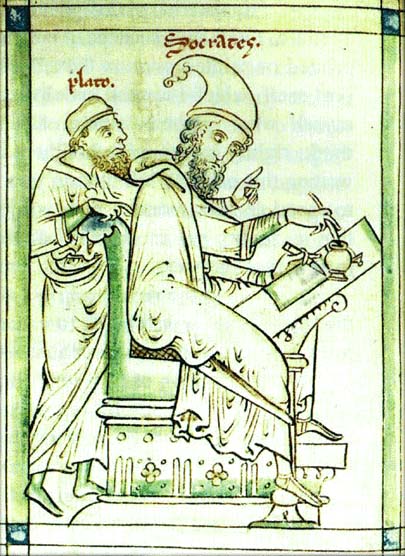
I tell you this long story, friend Theaetetus, because I suspect, as indeed you seem to think yourself, that you are in labour-great with some conception. Come then to me, who am a midwife’s son and myself a midwife, and do your best to answer the questions which I will ask you. And if I abstract and expose your first-born, because I discover upon inspection that the conception which you have formed is a vain shadow, do not quarrel with me on that account, as the manner of women is when their first children are taken from them. For I have actually known some who were ready to bite me when I deprived them of a darling folly; they did not perceive that I acted from good will, not knowing that no god is the enemy of man-that was not within the range of their ideas; neither am I their enemy in all this, but it would be wrong for me to admit falsehood, or to stifle the truth.

Socrates in Plato’s Theaetetus

socrates_and_plato

           When we think about philosophical education, I shall argue, we also need to think about thinking. Thinking is the power whose exercise causes philosophy to exist, and thus must be taken into consideration when we ask about philosophical pedagogy.  Philosophers think, but thinking also takes place in life more generally: a novel or a painting, a film, a meeting, a relationship, a task or a night at a club all involve the exercise of thought: these also are stimulants to thought. Though thinking happens whether we teach it or not, pedagogical interventions can have an effect.  This intervention from philosophy is necessary because thinking is shaped by a general pedagogy of social exposure which involves powerful targeted interventions from other institutions.  Depending on which school of philosophy one affiliates oneself with, one will offer a formulation of this pedagogical exigency in different terms, but it will always be necessitated by these institutional pressures. It is the job of philosophical education to be a midwife to thought: to watch over and attend to the dangers that threaten the precarious moments of its birth.

1. What experiences are formative for the human person?

           There are two certainties in life: we think and we die. This brings about a tension which is important for people: thinking is infinite and inexhaustible, we, on the other hand, are finite. When we think, we participate in something whose full dimensions we can never fathom as individuals.  It can be imagined along the lines of what has been called infinite semiosis.  Augusto Ponzio explains infinite semiosis as the “unending chain of deferrals from one interpretant to another.” (Ponzio 2) Thus, it would be impossible for me, as for any other individual, to follow out the infinite chain of semiotic deferrals: I would die before coming to the end. This excess of semiosis over the individual leads him or her to refer to the community for the meaning of the series, but all that he or she can find there are “namings” based on arbitrary arrests of the process. Though infinite semiosis is a good clarifying analogy for the infinite process of thought, thinking is not semiosis—it is not just the action of signs and meaning.

        Every ‘semiotic process’ is a sort of tracing of an exercise of thought. This tracing is the best that people can do because pure thought is inexpressible. This tracing is accomplished through the imposition of what one might call a ‘logic’ or a ‘semiotic.’ When I say that a semiotic process traces an exercise of thought, this is not to be confused with a philosophy, if by philosophy we mean an explicit metaphysical system.  From this perspective, ‘philosophy’ is what happens when thinking stops–when there is an arrest and solidification of thought (Kuhn’s normal science is the result of a slowing down of thought). Thinking is formative for the human person, if that human person is so fortunate as to exercise thought and recognize its powers. Though it is tempting to claim that thought is the essence of the human person, or of philosophy, thought cannot be the essence of anything because thought itself is constitutively impure. If it should appear, it would always bring a necessary entourage of incompatible powers. Books are an exercise of thought, a situational/evential unity in a sense similar to Austin’s in his HTDTWW.

              Each exercise of thought reveals new abilities, in this sense, we can affirm that each act strengthens the power of thought.  In addition, through the constitutive impurity of thought, we can infer that the scope and power of the human body is generally augmented by each ‘exercise of thought.’ It is in this sense that thinking is formative for a human person.  It seems to follow that thought, as it grows more powerful, causes changes in relationships and emotions, broader changes in the style of a person’s life, and their social life more generally. Thought is impure, it always appears in relation to these ‘outside’ factors: whether it is dominated by them or dominates them is a historical question, a matter of chance.

1.1 Can those be taught? 

             Thinking is the social practice that individuates us. Much is made of the role of education in socialization, but not as much ink is spent on the role of education in the process of individuation. Thinking stands at the interface of the individual and the social, each act of thinking is uniformly perfect and singular. Thinking is never entirely conscious for the individual because it is social, it is never entirely conscious from a historical perspective because it is singular. Thinking is at the interface of the individual and the social, it is a power, it occurs whether it is explicitly instructed or not.  However, we can also say that thinking must be ‘taught’ if we regard social exposure as a pedagogy. Insofar as institutionalized instruction of various kinds participates in a general pedagogy of social exposure, it can exert force over thought, and participate in or appropriate it. This can also be said of books, political events, walks taken in mountains or cities, conversations and so on: without these different forces, thinking would not occur—thinking needs these external elements of its essence. Philosophical problems are examples of concentrated long term thinking, they reveal much about the true power of thought and can be a great stimulant to thought in its development. Philosophy is not unique in this distinction, but it consciously advances a noology, and compares images of thought. Philosophy has also developed models of the role that the structure of our thinking plays in constituting our experience of reality, it can teach us to recognize the needs of the understanding as they attempt to impose themselves on our experiences of reality.

2. What is the proper method and goal of a philosophical education?

            We can say that the goal of philosophy is thinking, if by goal we mean a qualitative transformation that something strives toward which gives life to it. In this sense, the goal of sport and war is victory—playing and fighting are aimed toward a future event of becoming victorious.  When the game ends or the battle subsides, the successful fighters or players become victors. When philosophical education ends, we hope that students will become thinkers. Philosophy and thinking are related yet opposed: because we are finite and we develop our symbolic systems as part of our political life, the infinite potentialities of thinking are named using philosophical concepts which are finite. If philosophy participates in thinking in the sense that it is a partial crystallization of an exercise of thought, philosophical education must address this history of thinking.  This is nothing very new, the history of philosophy has been a sort of longitudinal study of thinking through its exercise.  Philosophical education should prepare a person to study thought in this sense; however, ‘philosophical’ education would not be the whole story, as thought is necessarily impure in its exercise, a comprehensive method would also need to prepare a person to address this impurity in the exercise of thought. A proper philosophical education would be as Socrates was to thought: it would be a midwife. It would not be a healer, restoring normalcy to thought, but would aide thought in coming to birth.

           The distinction between thinking and philosophy is especially important when we discuss pedagogical method.  Thinking without the influence of some sort of ‘cultivation’ or ‘pedagogy’ is impossible due to the existence of an inescapable general exposure, and in this general exposure, philosophy has many formidable competitors for the attention of the public.  Advertising, medicine, ritualized time keeping and holidays, in addition to myriad other discourses and practices begin to influence the child from its first breath, and the earlier philosophical education intervenes the greater its chances to establish itself, and hence the greater its opportunity to achieve its goal.  Philosophy, as embodied in the writings of Schopenhauer or Spinoza, would be unintelligible to a four year old; however, thinking itself is something familiar for that child, it is a game that he or she is constantly playing.  If the proper goal of philosophical education is to cultivate thinking, this education should start as early as possible. It should likewise be adjusted to fit and challenge the developmental needs and potentialities of this wide range of students.

        If we assume that it is politically possible to establish philosophical education across this age range, how do we deal with the varied powers and abilities of our students? Developmentally, there are significant differences between a graduate student and a kindergartner that must be factored into a theory of philosophical education.  In my thought on this matter, I have come up with a pair of gradient scales that illustrate the progression from K-PhD for our purposes.  These should not be taken as dogmatic, but instead they should be read as a useful shorthand. They are called ‘gradient scales’ because there is significant overlap: the consumed media can be varied at each level, as can the produced media. However, the chart does serve as a shorthand for the limits that developmental progression places on philosophical education.  The top gradient describes the age of the students, the second describes the appropriate media for student consumption in the classroom, and the bottom describes the appropriate media for production.

Elementary     Middle School                        High School                             University

Games        Tht. experiments/Scenarios      Mediated text      Primary/Secondary Sources

Art/Game/Discuss  Art/Discuss/Short Write    Art/Discuss/Writing     Art/Write/Discuss

          As we can see, the production of art should always be an important component of philosophical education.  It is the activity that links philosophical education across age and developmental levels.  This chart basically shows two progressions: first, the student progresses from smaller to longer textual productions, and second, he or she begins to engage with full, unmediated, primary texts. These progressions follow the expansion of thought and of the power of assembling stimulated thought in order to present it. Art is a powerful tool in the development of the latter capacity: it allows people to engage with and share thought that it is difficult for them to put into language.

3. Should such an education shape our political and social life? Or does it serve
other ends?

      The introduction of comprehensive philosophical education in the sense I have described above, can come to be an event, in Alain Badiou’s sense of that word, only if there are “militants” who recognize the event as event (citation Ethics) as there were for Socrates at Athens.  Otherwise, this happening will remain an unnamed non-event, and be assimilated into the order of things, or the “situation” as Badiou calls it.  Whether it finds its militants or not, philosophy as a social institution needs to distinguish itself from some social institutions that are related to thought, and it needs to align itself with others. Thinking and philosophy have different social agendas: while philosophy seeks alliances and enmities, thinking is an orphan, or to borrow a turn of phrase from Aristotle, ‘[it] is like the “Tribeless, lawless, hearthless one,’ whom Homer denounces (Politics, 7).”  Philosophy is a social institution, thinking is a power.  A ‘Socratic’ education that nurtured new thinking as it emerged by exposing it to thinking shaped by the history of philosophy would be a stimulant to thought. However, this same history can also be used to humiliate and depress thought, as Deleuze puts it:

The history of philosophy always been the agent of power in philosophy, and even in thought It has played the represser’s role: how can you think without having read Descartes, Kant and Heideggerand so-and-so’s book about them? A formidable school of intimidation which manufactures specialists in thought—but which makes those who stay outside conform all the more to this specialism which they despise. An image of thought called philosophy has been formed historically and it effectively stops people from thinking…thought borrows its properly philosophical image from the state… (Dialogues, 12)

In other words, this change in philosophical education will inevitably have political and social consequences, whose value cannot be determined a priori.  It is just as ‘natural’ for philosophy to kill thought as it is for philosophy to nurture it: which of these roles philosophy plays depends on how philosophy is appropriated, not necessarily on its history or its essence. We can have Socrates thinking fearlessly and encouraging the same in others, or the Pythagoreans murdering a man for discovering an unsolvable mathematical puzzle.

       If we concretize this problem a bit, and look at it in the context of contemporary education and political life in the United States, we can make an estimation of several courses that this process could take, given the ascendency of different forces in its implementation.  In the broadest sense, we will have forces contending for maintenance of the status quo and forces contending for its alteration or abolition. These forces will have different models of thought, which outline what it is, and what it can and should do.  These models would become explicit in the various approaches to philosophical education that would be implemented should these forces gain power.  Their models would focus on different aspects of thought, and background others: this direction of attention can be called a politics of thought. This politics of thought would me most visible in assessment targets and assessment methods.

       This direction would have two aspects: internal emphasis of components of philosophy to privileged positions, and external emphasis on the models and concepts in other fields. These two usually work in tandem, with certain disciplines having greater or lesser affinity with different elements of philosophy: mathematics and logic, art and aesthetics, and so on. Badiou has also offered us a schema for analyzing this situation in his concept of the suture.  He would have us believe that philosophy should not rely too much on any one external discourse, or ‘truth process’ as he calls it; philosophy should keep its distance from the particular arts and sciences even as it engages with them.  If it does draw too close to any particular discourse, it enters into a ‘suture’ which is philosophical disaster, and leads to totalitarian delusions of grandeur and errors.  For example…(phil as art, as science, as politics etc etc) Thus, we could assert that the militant of thought would have allegiance to thought as separate from the other disciplines, including philosophy and its components, and would need to implement a philosophical education that placed philosophy alongside the other fields without assimilating it to them.  This would be in contrast to the other forces which would instrumentalize thought through an assimilation mediated by philosophy in the “represser’s role.” This can involve any of the sutures that Badiou discusses, and has been put forward in greatest relief by two movements, scholasticism and positivism; in the one philosophy was the handmaiden of feudalism and theology, in the other of capitalism and natural science.

      Overall, philosophical education must encourage the fearless exercise of thought.  The history of philosophy offers many examples of this, as do the histories of the arts, the sciences, and the other disciplines and fields of activity.  Thought has too often been plagued by taboos, as many of which have been imposed as removed by philosophers.  If philosophical education is to be significant in human life it needs to help liberate people from their fear of thought, as Kant put it so many years ago:

 Having first infatuated their domesticated animals, and carefully prevented the docile creatures from daring to take a single step without the leading-strings to which they are tied, they next show them the danger which threatens them if they try to walk unaided. Now this danger is not in fact so very great, for they would certainly learn to walk eventually after a few falls. But an example of this kind is intimidating, and usually frightens them off from further attempts. (What is Enlightenment)

Philosophical education should provide all the support it can in these initial shaky moments of thinking.  This brings forward the most difficult problem of philosophical education, namely the problem brought to our attention by Heidegger, when he said that the goal of teaching was to ‘let  learn’ (What is Thinking).  Our greatest challenge can perhaps be met by a commitment to thinking over and above all other fields, even philosophy itself, in philosophical education: if we choose to think of philosophical education this way, we will maintain our vigilance against the sutures that Badiou brings to our attention, as well as this historical straight-jacketing criticized by Deleuze.  By focusing on thinking, something non-finite, something constantly changing and growing, we can also engage in the sort of pedagogy that does not have allegiance to any particular field, but lets thinking emerge free from taboos and become more powerful in an autonomous way.  If this sort of education begins early enough in a person’s life, and continues, it will become a significant part of their way of life.  If autonomous, fearless thinking was made generally available, the forms of political and social relations that depend on ‘voluntary servitude’ in Boetie’s sense would be more frequently challenged and overthrown. The fear of thinking is the fear of committing to the demands of lucidity.