Well burrowed, old mole!

Essays on Philosophy

Category: philosophy

Drama and Rhetoric

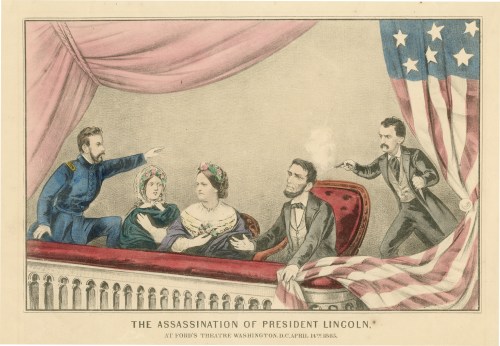
shooting1

Some people believe that unity of action in drama refers to the presence of one all-encompassing unity, a single self-consistent action that is the subject of the drama. How one interprets this element of drama depends on a reading of the word action, a delimitation of its meaning. Action is ambiguous between the deed and the event. Action can mean a single deed done by a subject; however, it can also mean a combat of armed soldiers, in other words, it can also describe a grand and multi-subjective action. This is an action undertaken by groups of people. No single subjectivity can be held responsible for it. If we reflect for a moment, all action in drama is of this nature; there is tension between multiple characters, it is not the self-consistent act of one subject, but rather the actions of multiple subjects that give rise to the continuing action of drama.

Read the rest of this entry »
On Work

bourgeois-pig

Serving the bosses is going out of style. The bosses, o the bosses, those bosses. The ‘boss’ mentality is an evolutionary atavism: in a sane society, what we call a boss, a general, a banker, economist etc. would be referred to as a sociopath. The bigger the boss, the more monstrous the deformity.  Serving these bosses is going out of style.

They have robbed the country in broad daylight. They are snatching the bread from our mouths with their austerities and budget hoaxes. Under the Ancien Regime, the bosses were exempt from all taxation and we see the return of this now.  The bosses are demanding a total reduction of the social wage under the guise of budget cuts. Who has stepped forward to denounce this and call for action? This is a declaration of total war. 

Read the rest of this entry »

Stockholm Syndrome And Political Subjectivity

witchburning

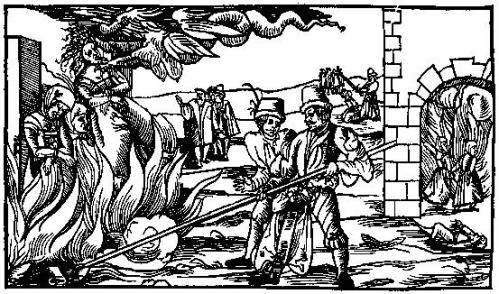
Wikipedia, drawing on the work of Nils Bejerot, defines Stockholm  syndrome as follows:

Stockholm syndrome is a psychological response sometimes seen in abducted hostages, in which the hostage shows signs of loyalty to the hostage-taker, regardless of the danger or risk in which they have been placed. The syndrome is named after the Norrmalmstorg robbery of Kreditbanken at Norrmalmstorg, Stockholm, Sweden, in which the bank robbers held bank employees hostage from August 23 to August 28 in 1973. In this case, the victims became emotionally attached to their victimizers, and even defended their captors after they were freed from their six-day ordeal. The term “Stockholm Syndrome” was coined by the criminologist and psychiatrist Nils Bejerot, who assisted the police during the robbery, and referred to the syndrome in a news broadcast.

In other words, Stockholm Syndrome is a response to a traumatic event wherein the subject forms a loyalty bond to the other that inflicts violence on it. This process also describes the constitution of political subjectivity through trauma—it is the logic of the social bond. The International Dictionary of Psychoanalysis defines trauma as:

an event of such violence and suddenness that it occasions an inflow of excitation sufficiently strong to defeat normally successful defense mechanisms; as a general rule trauma stuns the subject and, sooner or later, brings about a disorganization of the psychic economy.

As politics is always as much about reproduction as production, political subjectivity is perpetually reproduced by new trauma and by events which trigger the return of old trauma. As Freud put it in one of his models of the traumatic process:

traumatic effect came into play only…on the occasion of a second scene that served to reactualize the repressed memory of the earlier one.

These events must continue to occur, or political subjects will begin to break down. This recurrence is accomplished externally and internally. Consider a subject who is ticketed for parking illegally and later reminds him or herself not to park in that spot again: there is a chain of events which begins outside the subject and continues inside of it.

Consensus and Violence

houghton_ec-b1328-620ib_-_novum_organum_scientiarum

As Lord Bacon said, scientia potentia est: knowledge is power. Bacon warns the inquirer, the natural philosopher against the ‘four idols’– various forms of social prejudice– as obstacles to inquiry, and claims elsewhere that his inductive logic is superior to Aristotelian logic because it can be used to create new knowledge that makes life better, not merely to codify established truths. This seems like a great idea, science alleviating human misery; however, for Bacon, science can only investigate nature, it cannot inquire into matters of church and state. 

Read the rest of this entry »

Ethics Practice Becoming

mv5bmjmwnzmzmtq0ml5bml5banbnxkftztgwnjexmzuwnje-_v1_ux182_cr00182268_al_

     Aristotle said that Ethics is not like other forms of knowing.  It cannot tell us what is ethical, for this decision must be made on a case by case basis by the individual, but it can look into the means by which one can become ethical. He gives us a very impressive explanation of how one comes to be virtuous; it is through doing virtuous things that one acquires a virtue, so, if I want to be brave, I should do brave deeds then I shall become a brave person. Aristotle calls this type of knowing practical science, this is not the same as theoretical science because it cannot specify details at the same granularity. 

     It is interesting to consider the relation of means and ends in this schema of virtue acquisition; it seems that the Platonic idea of Virtue as its own end is here faced with the idea of Virtue as its own means.  In both of these schemas it can be said that virtue is not a means to any other end, but these two different ways of disagreeing with that idea have very different implications.  Ethics only studies the means of virtue, how one becomes virtuous, it does not tell us what is virtuous in detail.  For Aristotle ethics is not a metaphysical thing, it is inseparable from politics; for Plato, Ethics is metaphysical and is related to the idea rather than the act. 

Read the rest of this entry »

On The Origin of Human Knowledge

g1code

A Cluster of Problems

I.  Series’ and Meaning                                                            

When we think of the meaning of words, we think usually of their use in propositions and sentences.  Some of these sentences are attempts at definition by various dictionaries and scientists and so on.  If we look in greater detail at these definitions we can see that they refer to other definitions, which in their turn refer to other definitions.  This is called the ‘infinite regress’ and this is the essential and irreducible feature of language, its fundamental truth. 

     It is possible to view this chain of reference as being one of many which construct a web or a field which is the matrix from which uses of language draw, and which, on the whole, constitutes a language’s semantic structure.  When looking at definitions, we see certain concepts or signifiers which are used in an attempt to stabilize the system of reference.  These can be called centers, and language can be said to rely on a network with multiple centers from which it draws meaning.

     The idea that language has stable meaning is analogous to the way a counterfeit bill remains ‘legitimate’ so long as it is passed from hand to hand.  What this process requires is not a positive belief in the legitimacy of the bill; it requires the non-presence of disbelief in the bill’s legitimacy.  Despite what the logician might say, ‘I believe’ and ‘I do not disbelieve‘ express two differing positions. One of which is a positive belief and one of which we can call a negative belief.

      Read the rest of this entry »

Thoughts on the Disaster

*   *   *   *   *   *   *   * ***

hqdefault

“It’s hard to resist the temptation to hope for disaster, for systemic collapse…an event that will destroy the whole thing….but who is it that suffers, that dies in those events? It’s not the well-heeled  banker…a die-off can’t be a political program…”

Read the rest of this entry »

Economy and Taboo

bla3-300x220

A society’s most potent taboos are shadows of its highest values. 

Consider prostitution in relation to the historical institution of marriage; both involve an intimate exchange: the former producing money, the latter producing capital. Taboos are ontologically necessary preconditions of the “sacred.”  In order for the sacred to be, it needs to enjoy something we can call a ‘semiotic monopoly.’ Its signs must remain pure; irony is to be avoided at all costs.  In other words, the sacred gestures and ritual attitudes must not be appropriated without warrant: there must be strict and pitiless felicity conditions imposed.  Violations of these conditions of felicity are called taboos, and they carry strong punishments, not the least of which is the imputation of insanity, being declared mad.      

Read the rest of this entry »

The Courage of Truth

Courage

Who among us has the courage to utter the unspeakable? This type of courage is what is most necessary in free human beings.  The person who possesses this type of courage is the only human being who can claim to be honest.  Knowing what any group defines as the unspeakable is a major key to that group’s motives and nature.  We should always ask ourselves, what is it not possible to articulate within their way of speaking?

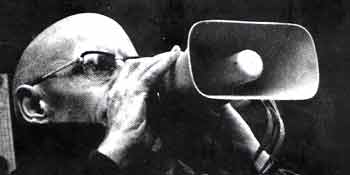
foucault

It is often regarded as cruelty to perform the act of speaking the unspeakable.  However this is one case where cruelty should have  positive connotations because cruelty contains an element of fearlessness which is foregrounded in this act.  Thus, there is the English expression regarding the cruelty of some truths.  The articulation of the unspeakable is often the result of a pitiless evaluation, a ruthless evaluation, an evaluation that does not judge in terms of good and evil.  This should be contrasted with the Kantian critique, the critique that justifies its object,  whose axiom is that one should begin by believing  in that which one criticizes. 

Consider a person who walks into a shopping mall and says, “the necessity of work is a myth that is used to enslave us” or the scene in I Heart Hukabees where the fireman character states that Jesus can in fact be mad at someone who believes in him, that faith is not enough.  Another example would be the case of Dr. Wilhelm Reich, and the persecution that he endured for bringing out the connections between politics and sexuality.  What do all of these people have in common? They all have the courage to articulate that which a certain situation is configured to hide. As Hegel put it, “The courage of truth…is the first condition of philosophising.”

Read the rest of this entry »

Notes on Deleuze ‘The Image of Thought’

dialectics-1

Preliminaries

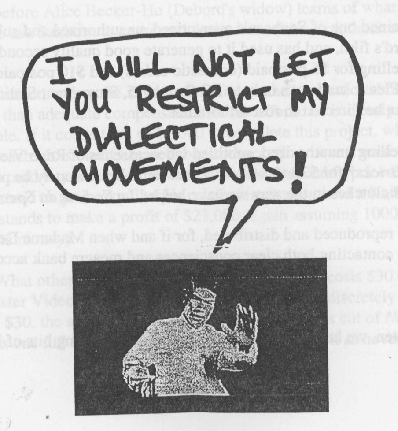
*Critique requires close attention to the distribution of the empirical/transcendental-de facto/de jure–fact/principle–accident/essence in theoretical systems.

*Dogmatic/Moral/Orthodox image of thought exists as a set of postulates–propositional themes which remain implicit and are understood pre-philosophically

*A Philosophy without presuppositions (‘thought without image’) is the philosophy which undertakes a radical critique of the postulates/the image of thought as non-philosophical. Image is non-philosophical because philosophy is supposed to break with the doxa. 

*”The form of recognition has never sanctioned anything but the recognizable and the recognized; form will never inspire anything but conformities”

*This is an idealization of orthodoxy–instead of a break with the doxa this is a rationalization that universalizes them–a break with the doxic content but retention of the form.

*We will “remain slaves so long as we do not control the problems themselves, so long as we do not possess a right to the problems, to a participation in and management of the problems”

Where philosophy begins–problem of presupposition, problem of beginning

Philosophy≠Science–science has only objective presuppositions eliminable with axiomatic rigor; philosophy has objective and subjective presuppositions.

Philosophical Trick–reject objective presuppositions on condition of assuming subjective ones

Objective Presupposition Subjective Presupposition
Explicit Implicit
In Concepts In Opinions (Doxa)
Public Private
Pre-conceptual/ Non-conceptual knowledge–‘Everybody knows…’

Eudoxus vs. Epistemon–Simpleton and pedant, both have presuppositions, Philosophy sides with Eudoxus and his subjective presuppositions. But philosophy ignores…

Underground Man/Untimely/Idiot–person who does not share the implicit presupposition–the only one without prejudices.

Read the rest of this entry »