Well burrowed, old mole!

Essays on Philosophy

Category: Ideology

Laclau Notes Session 4: Contingency in Theory

1. Back to the Ancients

     The most ferocious attack on Rhetorical Theory came from Plato.  He claimed that rhetoric had no epistemological value at all. Rhetoric is concerned with the discursive movement of deliberation and not the question answer and two term choices which dialectic employs. In the Gorgias, Platon condemns rhetoric because it offers no coherent account of its own status as a form of knowledge, and because it is not possible to delineate a class of objects with which rhetoric is concerned.  Rhetoric is nomadic; it has no specificity and no domicile.  It is to be considered defective and incomplete by a Platonist because it offers a false ontology; it deals with the appearance of truth and good not the definition of the truth or the good.  It offers no epistemological certainty or foundation.  Above all, Plato judged rhetoric to be an amoral instrument of practical politics, unlike ontology and epistemology of course.  A paradox emerges from this account: though rhetoric is tangible and deals with the tangible its arguments cannot stand up to critical scrutiny. 

Read the rest of this entry »

Laclau Notes Session 3

Review of the History of Rhetoric in Relation to Philosophy

1. The Ancients-Form and Matter     

     For the Greeks, what is sayable of an object is universal, but we must ask, what is the “it” which receives the predications?  For the Greeks all predicables are universals; they make up the form or the rational and knowable part of the entity of the object.  The “it,” the irrational and unknowable individuation that remains when you take away all predicables, is called matter. The Greek thought of the universe as a scale.  At the bottom was the unnameable primary matter hyle.  The first principle of organization was the mineral world where form was imprinted on this primary matter.  The mineral world was as matter to the vegetable world, the vegetable to the animal, the animal world to man, and on top the Gods were pure form and stood as matter in relation to nothing.  

Read the rest of this entry »

Laclau Seminar Notes Session 2: Floating Signifiers and Heterogeneity

614d92f60a37cc6f9ddc73a949e5c091


  • The Moment of Hegemony

 Screen Shot 2016-03-27 at 12.36.23 PM    

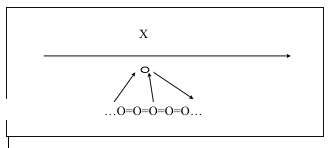
This is a simplified depiction of the moment of hegemony.  The X represents those on top of the frontier.  The antagonistic frontier can be said to be power, the X is sometimes a government.  It can also be the ruling class within a society.  The O’s below the frontier are the oppositional desires or the demands of those who are below the line.  The oval which is raised above the Os is the empty or hegemonic signifier, the arrow shows its origin from a particular desire or demand. These particular demands are arranged in an equivalential series by the emergence of the hegemonic signifier, the universalization or emptying of the hegemonic signifier is represented by the lines stretching from the oval to the chain of Os. 

This is a depiction of a situation in which those who are below the frontier of power have a series of demands which are unmet, and though their demands are different from one another, those who have these differing demands come to see them as equivalent and form a group under the articulation of one particular demand which comes to stand for opposition to X.  For instance, if many people have needs which are unmet in present day America, such as the need for affordable housing and health care, the desire to have more efficient garbage pickup in their neighborhood, the desire for a humane foreign policy and so on, they may end up campaigning for these diverse goals through the mediation of a group which articulates a different demand.  If these demands remain latent in the population, at any given moment if another group launches a large scale protest those with latent demands may join it even though it does not articulate their particular concern because it articulates unmet demand. 

     The X is in fact a group of people.  In order for them to maintain their position above the frontier, they must restrict the formation of such an equivalential logic.  If those who live under power can form a large enough equivalential chain they can overthrow those who are not meeting their demands.  There are two means by which the X will seek to keep the equivalential chain from forming, by articulating a logic of difference, or by constructing an alternative logic of equivalence. 

Read the rest of this entry »

Critical Notes on Ernesto Laclau’s Seminar on Rhetoric and Hegemony

Session 1: Introduction to Laclau’s Theory of Hegemony

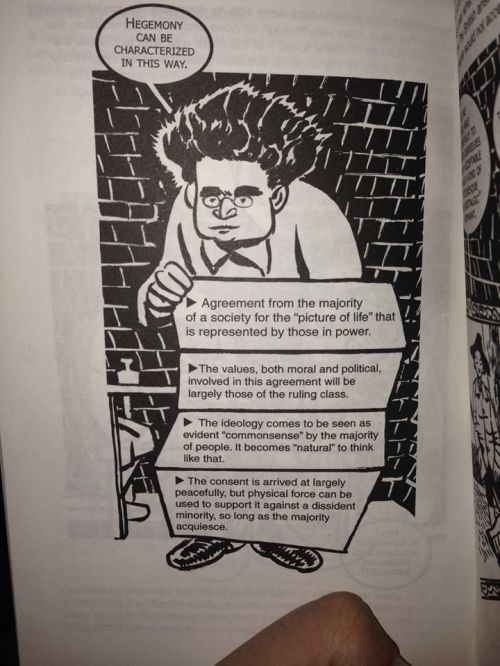
gramsci

1. Illusions of Modern Bourgeois Philosophy

     At the beginning of the 20th century three new developments in philosophy were taking place.  Each was based on a strategy which its proponents felt could grant immediate access to the thing in itself. The three strategies were analytic philosophy, phenomenology and structuralism.   All of their key words (referent, phenomenon and sign) played the role of what Levinas called a “neutralizing third term” they appeared to efface themselves in the process of bringing forth the unmediated truth of the world.  As time passed, these third terms became increasingly visible to practitioners of the strategies which they founded.  In the work of the late Wittgenstein and Richard Rorty, Martin Heidegger, Roland Barthes Jacques Lacan and Jacques Derrida we see a realization that the founding notions of 20th century philosophy did not grant the immediacy that they had promised.

Read the rest of this entry »

Notes on the Linguistics of Pecheux

monsieur-de-la-palisse

Notes are based on :

Michel Pecheux LANGUAGE, SEMANTICS AND IDEOLOGY  © Francois Maspero 1975 English translation © Harban, Nagpal 1982

Read the rest of this entry »

Occupy Wallstreet

bla3-300x220    

Written shortly after attending the events described below.

On September 17th 2011 it became apparent that something had changed in the United States. On that date, about 1,000 people arrived at the Bowling Green in lower Manhattan under the slogan “Occupy Wall Street.”  The call had been put out months before by Adbusters magazine, and had called forth an action that defied the logic of the typical permitted, pre-contained march.  In the park one could hear an open economics forum featuring speakers advocating the reinstatement of Glass-Steagall, denouncing the second law of thermodynamics as a fabrication of British Imperialism, calling for the global forgiveness of all debts, among other things.  Alongside the forum one could hear calls to shut down the Stock Exchange, to abolish debt-money and so on.  Here debates were reopened that had been shut down for a century at least.  A depoliticized society began to stir…

Read the rest of this entry »

Violence and History

Do we as a species have a compulsion to destroy our own history? No, not as a species. It is only a few of the pseudo-species that we call nations who do.

1899_sm_thats_what_uncle_sam_and_johnny_bull_could_do_1

Consider what the United States did and is doing to Iraq. Is it jealousy for their lack of history that motivates them? Perhaps, but it is possible to have a short and glorious history. In the case of the American oligarchy, it is the content of their history that motivates them. To them, history is something they have to run from, escape from, eradicate and so on. It counts as evidence against them. They bulldoze the libraries and monuments to build shopping malls. Beasts.

     Let’s think of this more concretely.  Imagine the United States are a person. He is born vulnerable and charming, but as he grows he becomes quite the troublemaker. In his youth and adolescence he murders one continent and enslaves a second. Coming to maturity, he builds the most destructive weapon of war in human history, uses it, and then proceeds to hold the entire world in subjugation. Now where do we find Mr. America?

Read the rest of this entry »

Becoming Animal (Notes for a Book Review)

David Abram, Becoming Animal: An Earthly Cosmology, Pantheon Books, New York 2010. 336 pp., $ 26.95 hb., 978 0 375 42171 6.

The history of the civilized human being has amounted to the sixth mass extinction event in the history of the planet earth.  How are we to respond? What to do in the face of the converging apocalypses, the darkening horizon of a failed form of life? The problem of civilization is daily (com)posing itself before our eyes; it is for us to respond by articulating the problem and by acting upon its conditions. Capitalism, as the latest representative of the civilized project, has a world in store, a world like the one Jean -Cristophe Bailly describes in his The Animal Side: 

…sky without birds, the oceans and rivers without fish, the earth without tigers or wolves, ice floes melted with humans below and nothing but humans fighting over water sources. Is it even possible to want that? In relation to this tendency, which seems ineluctable, every animal is a beginning, an engagement, a point of animation and intensity, a resistance. Any politics that takes no account of this (which is to say virtually all politics) is a criminal politics.

David Abram’s book inserts itself into this context; it is deeply sensitive to the horror of a totally human world, and it puts itself forward as an act of resistance to this suicidal ‘humanization.’

     Abram’s approach to the problem as he sees it is not immediately political;  instead, he claims that what is needed is a preparatory step, a thoroughgoing critique of the assumptions that enable the civilized project, and an articulation of a new language that corresponds to a new form of life. He calls this “a necessary work of recuperation that allows us to re-encounter the social and political”  Before we approach the problem, we need a new way of thinking that enacts our interbeing with the planet.  We need to forge a curious kind of thought that follows the perceptual logic of our interaction with the earth as living beings.  The articulation of this new language takes as its point of departure a pair of questions concerning the attribution of meaningful enunciation:

1. What if logos is not the exclusive property of man?

2. What if logos “is engendered by the difficult eros/tension between the our flesh and the flesh of the earth”?

Perhaps so long as the human being, good bourgeois that he has been, claims thought and intelligence, claims meaning as his private property we will have no meaningful progress on the environmental front.  It is necessary to break out of the circle of interiority that sees thought as property. Abram traces the genesis of this failed world-outlook, or this failure to out-look back to a primal act of violence that we can see exemplified in Cartesian modernity and cognitive science.  To this he counterposes Spinoza and Shamanism, forging a sort of materialist animism.  He also sees himself as “Completing the Copernican revolution” in a sense rather different from that of Kant. He wants to combine attunement to the earth with intellectual rigor.    

But is “perceptual logic” enough? Seems individualist like phenomenologies so often do.  It cannot be denied that this book is something of a confessional, a testimony of a single bourgeois who has seen the light, a feel-good book that proves that they are not all bad etc.
Plato and Ideology

golden-age  

The most significant lesson that I draw from The Republic is that so long as there is luxury–i.e. class rule–there will be deception and tyranny.  The ‘city of pigs’ that Plato rejects is the crucial point in the story for me. I read Plato’s utopian writing as more of an exercise in following ideas to their conclusions than as manual for statesmen. What Plato does in this work is he attempts to rationalize privilege and he fails at it.  The book demonstrates the fact that privilege cannot be justified without using mass deception combined with censorship and the state sanctioned indoctrination of children.  The friends assembled to discuss justice do not reject the ‘city of pigs’ because it cannot be the just city, but because they (being from the privileged class in Greek society) were accustomed to a standard of living that involved luxury goods.  If they are privileged and they are the only ones in their society who have access to luxury goods, then to say that the city must have luxury goods is as much as to say that the city must have privilege. 

Read the rest of this entry »

The Problem of Postmodernism

stock-vector-coin-operated-automaton-153307646

In his essay, “Twilight of the Machines” John Zerzan speaks the truth about the “postmodern” age.  He is not a scholar in the bourgeois university,  as many other critics are, which means he does not have to jump through the hoops of academic convention; he may speak the radical truth. Zerzan speaks as a philosopher and a revolutionary, breaking radically with the “Washington Consensus” of market totalitarian society. 

Read the rest of this entry »