Well burrowed, old mole!

Essays on Philosophy

Category: Ethics

Laclau Notes Session 3

Review of the History of Rhetoric in Relation to Philosophy

1. The Ancients-Form and Matter     

     For the Greeks, what is sayable of an object is universal, but we must ask, what is the “it” which receives the predications?  For the Greeks all predicables are universals; they make up the form or the rational and knowable part of the entity of the object.  The “it,” the irrational and unknowable individuation that remains when you take away all predicables, is called matter. The Greek thought of the universe as a scale.  At the bottom was the unnameable primary matter hyle.  The first principle of organization was the mineral world where form was imprinted on this primary matter.  The mineral world was as matter to the vegetable world, the vegetable to the animal, the animal world to man, and on top the Gods were pure form and stood as matter in relation to nothing.  

Read the rest of this entry »

Violence and History

Do we as a species have a compulsion to destroy our own history? No, not as a species. It is only a few of the pseudo-species that we call nations who do.

1899_sm_thats_what_uncle_sam_and_johnny_bull_could_do_1

Consider what the United States did and is doing to Iraq. Is it jealousy for their lack of history that motivates them? Perhaps, but it is possible to have a short and glorious history. In the case of the American oligarchy, it is the content of their history that motivates them. To them, history is something they have to run from, escape from, eradicate and so on. It counts as evidence against them. They bulldoze the libraries and monuments to build shopping malls. Beasts.

     Let’s think of this more concretely.  Imagine the United States are a person. He is born vulnerable and charming, but as he grows he becomes quite the troublemaker. In his youth and adolescence he murders one continent and enslaves a second. Coming to maturity, he builds the most destructive weapon of war in human history, uses it, and then proceeds to hold the entire world in subjugation. Now where do we find Mr. America?

Read the rest of this entry »

Becoming Animal (Notes for a Book Review)

David Abram, Becoming Animal: An Earthly Cosmology, Pantheon Books, New York 2010. 336 pp., $ 26.95 hb., 978 0 375 42171 6.

The history of the civilized human being has amounted to the sixth mass extinction event in the history of the planet earth.  How are we to respond? What to do in the face of the converging apocalypses, the darkening horizon of a failed form of life? The problem of civilization is daily (com)posing itself before our eyes; it is for us to respond by articulating the problem and by acting upon its conditions. Capitalism, as the latest representative of the civilized project, has a world in store, a world like the one Jean -Cristophe Bailly describes in his The Animal Side: 

…sky without birds, the oceans and rivers without fish, the earth without tigers or wolves, ice floes melted with humans below and nothing but humans fighting over water sources. Is it even possible to want that? In relation to this tendency, which seems ineluctable, every animal is a beginning, an engagement, a point of animation and intensity, a resistance. Any politics that takes no account of this (which is to say virtually all politics) is a criminal politics.

David Abram’s book inserts itself into this context; it is deeply sensitive to the horror of a totally human world, and it puts itself forward as an act of resistance to this suicidal ‘humanization.’

     Abram’s approach to the problem as he sees it is not immediately political;  instead, he claims that what is needed is a preparatory step, a thoroughgoing critique of the assumptions that enable the civilized project, and an articulation of a new language that corresponds to a new form of life. He calls this “a necessary work of recuperation that allows us to re-encounter the social and political”  Before we approach the problem, we need a new way of thinking that enacts our interbeing with the planet.  We need to forge a curious kind of thought that follows the perceptual logic of our interaction with the earth as living beings.  The articulation of this new language takes as its point of departure a pair of questions concerning the attribution of meaningful enunciation:

1. What if logos is not the exclusive property of man?

2. What if logos “is engendered by the difficult eros/tension between the our flesh and the flesh of the earth”?

Perhaps so long as the human being, good bourgeois that he has been, claims thought and intelligence, claims meaning as his private property we will have no meaningful progress on the environmental front.  It is necessary to break out of the circle of interiority that sees thought as property. Abram traces the genesis of this failed world-outlook, or this failure to out-look back to a primal act of violence that we can see exemplified in Cartesian modernity and cognitive science.  To this he counterposes Spinoza and Shamanism, forging a sort of materialist animism.  He also sees himself as “Completing the Copernican revolution” in a sense rather different from that of Kant. He wants to combine attunement to the earth with intellectual rigor.    

But is “perceptual logic” enough? Seems individualist like phenomenologies so often do.  It cannot be denied that this book is something of a confessional, a testimony of a single bourgeois who has seen the light, a feel-good book that proves that they are not all bad etc.

Plato and Ideology

golden-age  

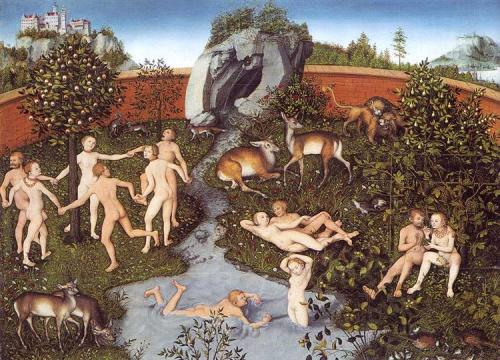
The most significant lesson that I draw from The Republic is that so long as there is luxury–i.e. class rule–there will be deception and tyranny.  The ‘city of pigs’ that Plato rejects is the crucial point in the story for me. I read Plato’s utopian writing as more of an exercise in following ideas to their conclusions than as manual for statesmen. What Plato does in this work is he attempts to rationalize privilege and he fails at it.  The book demonstrates the fact that privilege cannot be justified without using mass deception combined with censorship and the state sanctioned indoctrination of children.  The friends assembled to discuss justice do not reject the ‘city of pigs’ because it cannot be the just city, but because they (being from the privileged class in Greek society) were accustomed to a standard of living that involved luxury goods.  If they are privileged and they are the only ones in their society who have access to luxury goods, then to say that the city must have luxury goods is as much as to say that the city must have privilege. 

Read the rest of this entry »

My “Cosmopolitanism”

diogenes_in_thomas_stanley_history_of_philosophy

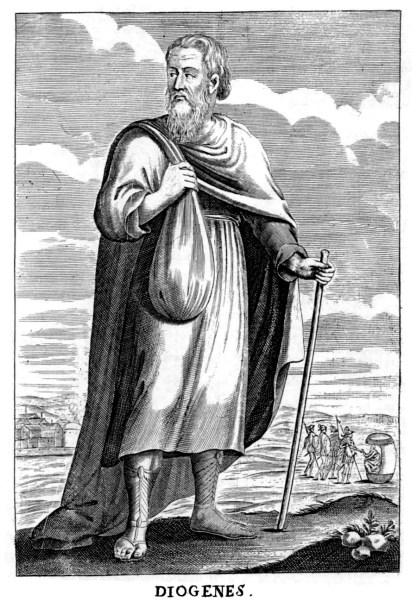
It is becoming increasingly difficult to find any work that is not collaboration with evil.  Workfare and food insecurity, the threat of becoming “surplus humanity,” of slums, work camps and prisons, battlefields; these things try to intimidate us into a collaboration with evil, but they can never succeed. It can never be said that we had to–there’s always that moment of heightened contradiction, of a decision for or against open collaboration. In that moment, it is equally possible to recognize the contradiction and repudiate all collaboration. Evil can never enjoy full and total monopoly because the earth itself defies it.

Read the rest of this entry »

Stockholm Syndrome And Political Subjectivity

witchburning

Wikipedia, drawing on the work of Nils Bejerot, defines Stockholm  syndrome as follows:

Stockholm syndrome is a psychological response sometimes seen in abducted hostages, in which the hostage shows signs of loyalty to the hostage-taker, regardless of the danger or risk in which they have been placed. The syndrome is named after the Norrmalmstorg robbery of Kreditbanken at Norrmalmstorg, Stockholm, Sweden, in which the bank robbers held bank employees hostage from August 23 to August 28 in 1973. In this case, the victims became emotionally attached to their victimizers, and even defended their captors after they were freed from their six-day ordeal. The term “Stockholm Syndrome” was coined by the criminologist and psychiatrist Nils Bejerot, who assisted the police during the robbery, and referred to the syndrome in a news broadcast.

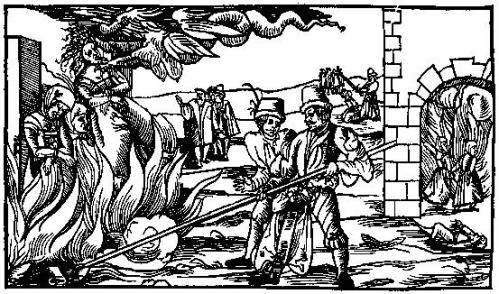
In other words, Stockholm Syndrome is a response to a traumatic event wherein the subject forms a loyalty bond to the other that inflicts violence on it. This process also describes the constitution of political subjectivity through trauma—it is the logic of the social bond. The International Dictionary of Psychoanalysis defines trauma as:

an event of such violence and suddenness that it occasions an inflow of excitation sufficiently strong to defeat normally successful defense mechanisms; as a general rule trauma stuns the subject and, sooner or later, brings about a disorganization of the psychic economy.

As politics is always as much about reproduction as production, political subjectivity is perpetually reproduced by new trauma and by events which trigger the return of old trauma. As Freud put it in one of his models of the traumatic process:

traumatic effect came into play only…on the occasion of a second scene that served to reactualize the repressed memory of the earlier one.

These events must continue to occur, or political subjects will begin to break down. This recurrence is accomplished externally and internally. Consider a subject who is ticketed for parking illegally and later reminds him or herself not to park in that spot again: there is a chain of events which begins outside the subject and continues inside of it.

Ethics Practice Becoming

mv5bmjmwnzmzmtq0ml5bml5banbnxkftztgwnjexmzuwnje-_v1_ux182_cr00182268_al_

     Aristotle said that Ethics is not like other forms of knowing.  It cannot tell us what is ethical, for this decision must be made on a case by case basis by the individual, but it can look into the means by which one can become ethical. He gives us a very impressive explanation of how one comes to be virtuous; it is through doing virtuous things that one acquires a virtue, so, if I want to be brave, I should do brave deeds then I shall become a brave person. Aristotle calls this type of knowing practical science, this is not the same as theoretical science because it cannot specify details at the same granularity. 

     It is interesting to consider the relation of means and ends in this schema of virtue acquisition; it seems that the Platonic idea of Virtue as its own end is here faced with the idea of Virtue as its own means.  In both of these schemas it can be said that virtue is not a means to any other end, but these two different ways of disagreeing with that idea have very different implications.  Ethics only studies the means of virtue, how one becomes virtuous, it does not tell us what is virtuous in detail.  For Aristotle ethics is not a metaphysical thing, it is inseparable from politics; for Plato, Ethics is metaphysical and is related to the idea rather than the act. 

Read the rest of this entry »