Laclau Notes: Session 5
by Mark S. Lennon
Immanence Revisited, Figures, General Strike
1. Immanence
Theories of immanence are tied to secularization. Spinoza’s formula shows the interchangeability of God and Nature as concepts. According to Spinoza, God or Nature is causa sui ‘cause of itself’–this is the only “substance,” all else is the product of external causation. These theories seem to deny contingency, they hold that existence is necessary. This type of theory is in opposition to the theories of transcendence. These theories posit a transcendent origin of the world, some external and greater force which set the world in shape and motion. Theories of transcendence come in two forms; theistic theories assert that God constantly intervenes in the world, deistic theories hold that God only intervened in the world at its origin. Deism is traditionally associated with immanence, the big bang theory is an example of a deistic theory of immanence, the universe unfolded itself, disseminated itself into matter. Though these viewpoints may have developed in theology, they can be seen in general culture, particularly in presuppositions about the nature of truth.
The modern theory of the dialectic was born out of this situation. It was articulated in response to the seemingly unsolvable problem of evil. John Scotus Eriugena explained to us that the existence of evil is apparent, God merely employs it to raise a higher form of Goodness. What seems to be evil is in fact a necessary stage. When John Scotus Eriugena gave his theory form, it was condemned because by implication God is not yet perfect, he must become perfect. This implication was contrary to orthodoxy. Hegel’s dialectic is very similar to this theory. It holds that history is not the terrain of happiness, in history there are contradictions. First, there is a lack of contradiction; then, a contradiction emerges, and finally we realize the rationality of the contradiction. Marx used a similar framework: he said that first there is primitive communism, then there is class society, and finally there is realized communism. However, Marx’s theory was different from Hegel Eriugena and Spinoza because his was materialist. While materialist readings of these other thinkers are possible, all of them ultimately refer their theories to some kind of transcendental God. Marx’s theory is not a theological doctrine it is a political, historical and scientific one.
2. Figures of Rhetoric
Gerard Genette’s works Restricted Rhetoric and Metonymy in Proust are significant contributions to the modern theory of rhetoric. Since the Middle Ages there has been a general tendency to reduce the field of rhetoric to the study of figures. Toward the end of the Middle Ages, under the pressure of more despotic regimes, rhetoric no longer concerned itself with the deliberative at all. Rhetoric was absorbed by grammar, it was only considered relevant to elocution; the study of argumentation was carried out under the name of dialectic.
In the 19th century, Fontanier published the last compilation of rhetorical knowledge in modern times. In this work he claimed to study all the figures of rhetoric including allegory and apply substitution to them. In 1730, Dumarsais had undertaken a study of rhetoric as well. He was trained as a semantician and was interested in the fact that the same word can have different meanings within one language. He proposed to study the distinction between the literal and the figurative and called this science ‘tropology.’ It would be the study of tropes.
In order to study the tropes, these theorists performed a division of tropes. Du Marsais gave a list of 18 tropes, this seemed too chaotic; most other theorists attempted to reduce the kinds of tropes further. Vossius attempted to reduce the tropes to 4 types, metaphor, metonymy irony and synecdoche. Fontanier would do away with irony; Du Marsais collapsed synecdoche and metonymy into one another. Du Marsais could have taken this even further. He assumes that metonymy generally functions by means of physical contiguity; however, metonymy is often rooted in metaphors such as effect for cause, sign for thing, or brain for intelligence, even if it is rooted in physical contiguity in some cases.
Lacan put forward the claim that all tropes can be reduced to metaphor, or replacement of terms. There is a problem with this ultimate reduction, some claim that if we assume trope monism we cannot study devices such as antiphrase. It seems that this problem derives from the distinction between the categories of image and symbol. The image needs to be visual and leads to the dominance of analogy and mimesis. The symbol is an object divided within itself between particularity and totality signification; at first, it is based in analogy but it comes to be based in metaphor. Both of these categories, all of the tropes, suggest that there is an identity between substitution and equivalence. Thus, metaphor is a much stronger link; however, as we can see from the ‘chameleon towers’ in Proust, metaphor can be grounded in metonymy.
Proust’s work makes apparent the crucial truth that metaphor and metonymy enter into involuntary memory. In the case of the ‘Madeline Evocation,’ the Madeline evokes the room which evokes the village; the chain begins with metaphor but only is extended into a narrative through metonymy. Without the metaphor through which we find lost time there are no true memories, without the metonymy that puts it in movement there would be no narrative no chaining. This happens through metaphor within metonymy. Jakobsen, studied the tropes using aphasiacs. Aphaisia is a language related brain disorder; there are 2 generally recognized types of aphasia which affect different areas of the brain, named after their discoverers, Broca and Wernicke.
Jakobson demonstrates a significant correlation between these 2 disorders and the rhetorical tropes metaphor and metonymy. One type of aphaisiac has trouble with combining terms, the other with finding synonyms. The first type corresponds to metonymy and epic poetry, while the second corresponds to metaphor and lyric poetry, one deals with a succession the other with an instant.
2.1 Metaphor Metonymy and Politics-The General Strike
We can see the distinction between metaphor and metonymy in the political approaches of Sorel and Trotsky. In the 1890’s Sorel saw Marxism in crisis, the necessary laws that were supposed by some to guarantee the course of future events had proven false to this promise. Sorel linked revolution to the need to forge a strong subjective will. He was a socialist because the proletariat was the only class free of bourgeois decadence; this was the only class not permeated by the spirit of bourgeois concession, they would be the only class capable of providing the violence which keeps the fighting spirit alive. To this end, he felt that “we need a myth” a set of galvanizing ideas which would lead to revolutionary action. This, unlike utopianism would not be an ideological product. His myth was the “general strike.”
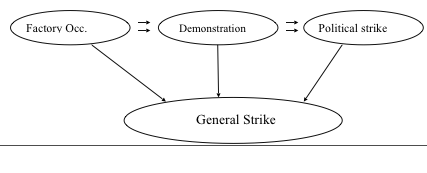
This differs from the ‘political strike’; the ‘political strike’ is one which is enacted for specific concession from employers such as shorter working hours higher wages, or safety concerns about working conditions. The general strike makes concession impossible, its only demand is the end of the capitalist system as such. As we can see in the above diagram, the bubbles on the top are in relations of equivalence; there are equivalent in two ways. First, they all represent partial objectives, they comprise the literal level of articulation. Second, they are all equally capable of leading to the general strike. The arrows represent the metaphoric displacement from the partial to the total which leads to the general strike. This approach is 100% metaphorical, one may object that it is synecdoche, but it does not become synecdoche until the overflow into general strike takes place.
We have already discussed Trotsky’s strategy of permanent revolution. In response to the lack of a capitalist revolution in Russian history, Trotsky advocates a nationalization of industries in order to bypass the bourgeois stage through constant revolution toward socialism. This solution is based on a narrative, it discusses a succession of stages, and the metaphoric moment is reduced heavily; thus, we can say that this approach is pure metonymy. Gramsci came along and formulated a theory which was both metaphoric and metonymic. As we have already seen, within a group for Gramsci there is a class core surrounded by widening circles of contingent hegemonic connections. He argues that a collective will is created by widening the sphere of equivalence of external elements. This is a Proustian solution; without metaphor there are no moments, without metonymy there is no history.
Appendix: Mysticism and Emptiness
Universality is the effect of concrete social and political operations.
The mystic operates through the via negativa attempting to avoid idolatry by never giving a name to God. In order to do this the mystic must appeal to: no(x…n)
and the all(x…n) these are ways of discussing that which can be named but not conceptualized. Thus, this is not exclusive to the mystic, but general to discourse. Emptyness is what we use in this case, it is the breakdown of signification, it prevents the total closure of the symbolic. Meaning is attributed to the empty signifier by the retroactivity of the name. Thus, Laclau views the particular as a discursive element, while Gasche claims that it is sensual.
 Well burrowed, old mole!