The Problem of Postmodernism
by Mark S. Lennon
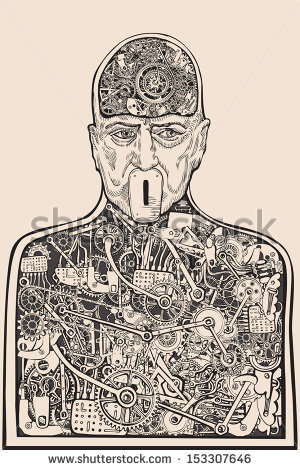
In his essay, “Twilight of the Machines” John Zerzan speaks the truth about the “postmodern” age. He is not a scholar in the bourgeois university, as many other critics are, which means he does not have to jump through the hoops of academic convention; he may speak the radical truth. Zerzan speaks as a philosopher and a revolutionary, breaking radically with the “Washington Consensus” of market totalitarian society.
He begins with a powerful example of the postmodern as a “postmortem” spirit. He cites a 1998 novel by Michael Houellebecq called Les Particulares Elementaires, which, “captured a joyless disillusioned modernism in which cloning comes as a deliverance” (Anarchy, 35). He also notes the underlying philosophy of this novel and the age: “Civilization itself has proved a failure, and humanity ends up liquidating itself in absolute surrender to domination” (ibid). He then reviews two other books, All Connected Now: Life in the First Global Civilization and What Will Be: How the new World of Information Will Change Our Lives. He finds that these books express,
Resignation to an even more standardized and bereft situation… the creative exhaustion and moral bankruptcy of an age, in which massive dehumanization and rampant destruction of nature vie for fulfillment of interrelated projects(36).
He finds that postmodernism is the surrender to all of this nonsense–TINA globalization etc etc–it is a pathological symptom.
Zerzan says, “The connection between the imperialism of technology and the loss of meaning in society never dawns on the postmodernists” (38). Zerzan gives the lie to the ideological cult of personality around Foucault, which has served as cover for most of the academy disavowing efforts to liberate humanity from technology and domination. Zerzan says that Foucault “facilitated the postmodern conceit that opposing oppression is passé”. He did this with what we can call his methodontological Kantianism–one must restrict oneself, no totalities, no transcendent conclusions etc etc. It is the influence of academics who use a certain Foucault as a grounding authority, in spite of his own real political positions, that daily divorces academia from the truth of what is happening in this world.
Zerzan then cites two sources, Seyla Benhabib and Marshall Berman, who sum up the basic premises of “posthumanism” the post-Heideggerean bourgeois-academic fashion. Benhabib sums it up in three theses:
-
The death of man understood as the death of the autonomous, self-reflexive subject capable of acting on principle;
-
The death of history…the severance of the epistemic interest in history of struggling groups in constructing their past narratives;
-
The death of metaphysics, …the impossibility of criticizing or legitimating institutions, practices and traditions other than through the immanent appeal to self-legitimation of ‘small narratives’” (38).
Berman says that postmodernism is, “a philosophy of despair masquerading as radical intellectual chic…the counterpoint to the civilizational collapse going on around us.” Zerzan also sees the collapse of the symbol system of bourgeois civilization, which encouragingly results in the increasing obviousness of, “the direct rule of technology and capital” (39). He provides an incredibly insightful summary of the age when he says,
“Born of the defeat of the movements of the 1960’s and grown even more embarrassingly impoverished during the post 60’s decades of defeat and reaction, postmodernism is the name for prostration before the monstrous facts”(38).
This is quite similar to the notion of “restoration culture” put forward by Dominique Lecourt in his book Mediocracy.
Reading Zerzan’s essay, I am left in a contradictory position; he is correct in his critique, but misleading in the conclusions he draws. Instead of utterly disavowing the postmodern as a poison pure and simple, he should realize that it is in fact a pharmakon, ambiguous between poison and medicine; he should affirm that postmodern art is any gesture that opposes the tendencies spoken of in the above summary.
Postmodern art is also a weapon of the people against the monster they have created, empowered and called ”civilization.” It can be a great tool to, “Empty out [their] minds of all the American garbage… law and order chatter that the gangsters sold us, fools/ all the military clatter and their costly useless tools” in the words of Allen Ginsberg, a great model of this (anti-)postmodern art of which I have spoken. If we are to survive the global transfiguring brought about by the new technologies we have yet to fully fathom, we need artists to circulate image-weapons to facilitate the composition of revolutionary consciousness in this conjuncture. In the above passage, drawn from “End the War in Vietnam” Ginsberg is addressing an America withdrawing from the cold war, and urging them to re-evaluate their paranoid anticommunist structures as they are no longer justifiable if they ever were. His advice has gone unheeded, and actually been suppressed actively in our country over the years under the flag of democracy. This only serves to reinforce the hopeless despair; the cultural pathology of postmodernism is maintained by force. It is not an organic movement, but the learned helplessness of humans totally subjected to capital. In his book, Deliberate Prose Ginsberg recounts a chilling instance of state censorship of media that goes unnoticed.
Recent history is the record of a vast conspiracy to impose one level of mechanical consciousness on mankind and exterminate all manifestations of that unique part of human sentience, identical in all men, which the individual shares with his Creator. The suppression of contemplative individuality is nearly complete.
The only immediate historical data that we can know and act on are those fed to our senses through systems of mass communication.
These media are exactly the places where the deepest and most personal sensitivities and confessions of reality are most prohibited, mocked, suppressed.
His attempt to break the hypnosis of postmodernism is actively opposed by the bourgeois state. What we call postmodernism is a case of social and cultural engineering. Ginsberg cites the activities of the Regan administration and of Jesse Helms to eliminate ”indecency” on the airwaves. He says:
The suppression of poetry in America can’t be mistaken for unpopularity…The mass media is controlled by the government, which bans poetry from the air from 6am to 8pm. Regulations forbid broadcasting most of the standard anthologies and texts that kids study in school, according to various laws put into place by Sen. Jesse Helms and others. Important poetry can’t get on the air as a great deal of writing, my own included will not pass the censor’s eye. ..Much poetry is in Jesse Helms’ view “indecent” language. Helms wanted-and Ronald Regan signed- a 24-hour ban which the courts later found unconstitutional. There is no free market for poetry since poetry that criticizes gasoline, petrochemical, fossil fuel, lumber, and agribusiness industries and the automobile industry won’t be sponsored. Poetry on the public education networks immediately gets attacked by the right wing as liberal and un-American. Little real poetry gets on the air… (Noticing What is Vivid 180-1)
He then makes it clear what he means by important poetry. He says, “ultimately the sense that the author is purposing to relieve the mass of human suffering” (183). In other words, considering the above remark in connection with Ginsberg’s background in eastern philosophy and western radicalism, emancipatory knowledge- both spiritual and political- is being active suppressed by the powers that be.
With this sort of activity going on, it becomes too obvious that postmodernism is a tool of the ruling class. It embodies what it stands for through what it condemns. It condemns activism on the behalf of the oppressed, therefore it is a tool of oppression; it condemns criticism of institutions, therefore it actively enables the perpetuation of their designs which are most times criminal. The philosophy that condemns criticism of institutions also condemns criticism of the environments they create. But, this criticism is the province of the artist. Thus, artists should criticize this tendency as an obstacle to the human race in general, but also as a threat against art as such.”Poetry” in Ginsberg’s sense awakens people to the invisible consequences of their ideologies and this is exactly what postmodernism opposes. It grows more difficult to disseminate such messages every day with media merging and deregulating and federal funds stripped from the arts. Postmodernism is a self-fulfilling prophecy; if one adheres to its tenets one takes a great step in the direction of validating them. As it is disseminated over mass media, it has the only claim to truth which can exist in the “postmodern world” the sheer force of appearance of naked repetition . Postmodernism like any thought environment is invisible and all-powerful for those within its enclosure. Its adherents for the most part do not even know what it represents so much as they adapt by default to its status as the “spirit of the age.”
Ihab Hassan lists “schizophrenia” as one characteristic of postmodernism (152). What exactly is schizophrenia? It is a mental illness which is characterized by a splitting of the personality and emotional deterioration. Deleuze and Guattari’s Capitalism and Schizophrenia project develops this position that the mass psychology of the postmodern age is schizophrenic. Each of us has the impulse toward hospitality and mutual aid which must be suppressed to perpetuate a system which feeds off of death and exploitation. In order to live in America a person must ignore so much misery that can be remedied. Marshall Mcluhan said that the electric technology is an extension of the central nervous system. He also said that in periods following the introduction of new technologies numbness follows. Perhaps we can say that postmodernism is a symptom of this numbness of the central nervous system mediated through the concrete exigency of having to be the type of culture which can exist simultaneously with acceptance of the criminal machinations of global capitalism.
Zerzan, John. “Twilight of the Machines” Anarchy: A Journal of Desire Armed Winter 2002-3 #54: 35-39.
Selya Benhabib. “Feminism and the Question of Postmodernism.” The New Social Theory Reader ed. Seidman and Alexander, Rutledge 2001.
Marshall Berman. The Twilight of American Culture W.W Norton 2001
 Well burrowed, old mole!